Components:
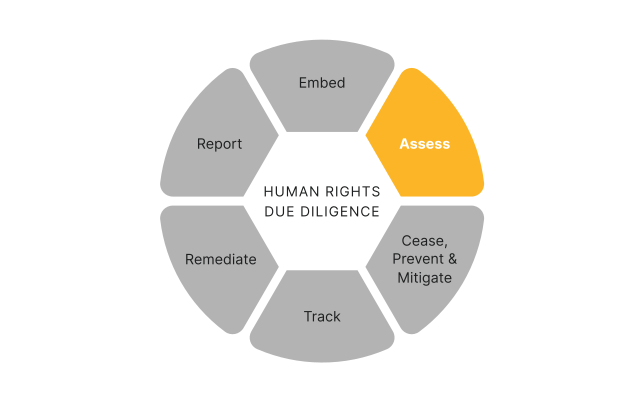
The “Assess” element refers to the processes by which companies take stock of human rights risks and harms caused by their operations and those of their supply chain partners.


Overview
Companies must establish visibility into their supply chain partners, workers, and producers to effectively assess human rights risks and adverse impacts associated with sourcing.
Companies achieve this visibility through supply chain mapping. This typically begins with Tier 1 suppliers and progresses to identify their suppliers’ suppliers down to the first mile level. While supply chain mapping differs from traceability—the tracking of specific goods horizontally and vertically across tiers—both systems enhance visibility into product origins and facilitate human rights due diligence (HRDD).
As a company’s level of visibility into its supply chain improves, it can begin to collect and use information relevant for assessing and controlling specific salient issues. For any company sourcing raw materials, full supply chain mapping is an important enabler of robust human rights due diligence.
Maturity benchmarking
Basic

The company has identified its Tier 1 suppliers and is gathering location and basic workforce information about supplier operations and supply chains.
How to get there:
- Identify all Tier 1 suppliers
- Systematically gather information (e.g. via questionnaire) about the identity, location, and workforce details of supplier facilities and supply chains
- Flag suppliers and/or supply chains known to be at risk for human rights issues (e.g. due to sector, geography, or workforce characteristics) for additional assessment
- Use supplier information to identify gaps in supply chain visibility and factors limiting access to relevant human rights insight (e.g. purchasing practices, lack of supplier traceability systems, high number of upstream producers, etc.)
Established

In addition to “Basic,” the company requires its suppliers to map their supply chains and to collect location and basic workforce information about them.
How to get there:
- Include requirement to provide supply chain location and workforce information in supplier precontracting due diligence and contracting processes
- Require suppliers in prioritized commodity-geography contexts to continually improve supply chain visibility (e.g. via extension of traceability systems, scientific screening for unacceptable origins, supplier surveys, etc.)
- Develop operational guidance for suppliers in prioritized commodity-geography supply chains about the information they should collect to facilitate assessment and control of human rights risk
Leadership

In addition to “Established,” the company has verifiable information about the origins of all commodities it sources, and it can access information about producers and workers in its supply chains in order to evaluate and control human rights risks.
How to get there:
- Require all suppliers to map supply chains to first mile level
- Require or implement third party verification of supply chain mapping and/or product traceability
- Include labor supply chain mapping in scope
- Work with suppliers to standardize, aggregate, and analyze relevant workforce, community, and farm profile data in order to assess and control human rights risks associated with supply chains
- Engage with government and industry peers to align traceability systems and share supply chain risk profile information relevant for HRDD
Further reading
Hershey's Milk Chocolate with Almonds supply chain map
Lindt & Sprüngli Achieves Sustainability Milestone: 100% Traceable and Verified Cocoa Beans
Protective Community Index
Risk Evaluation for Action in the Coffee Trade (REACT) Dashboard by Verité’s COFFEE project
Supply Chain Mapping and Risk Assessment in the Food and Beverage Sector
Supply Chain Mapping, Transparency, and Traceability
Supply Chain Traceability Matrix by Verité’s STREAMS project
Using Risk Maps to Protect Human Rights
Identify Risks in Your Company’s Global Supply Chains

Overview
A saliency assessment is a systematic process of identifying and analyzing all the risks to people’s human rights in a company’s operations and supply chains.
Effective saliency assessments require robust engagement with relevant stakeholders. Saliency assessments typically identify specific human and labor rights issues—such as child labor, forced labor, gender equality, and farmer livelihoods—that form the foundation for targeted programming like commodity initiatives and external partnerships. This process can catalyze important commitments and help focus senior leadership on human rights priorities.
Maturity benchmarking
Basic
The company has prepared for and resourced an assessment of its human rights risks to identify its salient issues, and it has identified commodities and geographies of focus.
How to get there:
- Identify commodities and geographies in the company’s supply chain that are known to be associated with human rights risks
- Select provider to carry out the saliency assessment and allocate necessary resources
- Agree on methodology and full scope of assessment
- Compile list of stakeholders to be consulted
Established
In addition to “Basic,” the company has completed a saliency assessment and identified the most salient human rights risks in its operations and supply chains.
How to get there:
- Provide relevant information to those conducting the assessment, and facilitate interviews with relevant internal and external stakeholders
- Undertake assessment and analyze results
- Share preliminary findings with relevant stakeholders, receive input, and finalize
- Use findings to create “heatmaps” or similar tools to represent the most salient issues in the prioritized commodities and geographies
Leadership
In addition to “Established,” the company updates its saliency analysis regularly and ensures that its understanding of its human rights risks is updated whenever there are significant changes in operations, supply chains, or laws and regulations.
How to get there:
- Refresh the saliency assessment on a regular basis at both country and commodity level
- Standardize protocol for triggers to revisit saliency assessment
Further reading
Forced Labor E-Learning Course
Fairtrade Risk Map
Forced Labor Risks in Food & Beverage Supply Chains: What Risks are Investors Exposed to and How Can They be Addressed?
Human Rights Due Diligence Training Facilitation Guide
International Child Labor & Forced Labor Reports
Sainsbury’s Human Rights Saliency Report 2021-2022


Overview
In-depth assessments complement broader saliency assessments by capturing detailed information on human and labor rights issues at sub-country levels.
This includes states, municipalities, communities, first mile operations, and small farm clusters. These assessments may be self-administered or done by a third party, and should always build on existing information, such as audits, internal records, and any existing data. Assessments should examine both the nature of existing human and labor rights issues and their underlying root causes. A strong understanding of root causes enables companies and suppliers to design more effective approaches to prevent problems from recurring.
Maturity benchmarking
Basic
Using information from the supply chain mapping and saliency assessment, the company has determined where a greater understanding of its risks is needed, and it has chosen an approach to in-depth assessments.
How to get there:
- Identify which salient issues, commodities, and geographies will be targeted for in-depth assessments
- Map relevant stakeholders and ensure they are engaged as part of the assessment(s)
- Decide if the assessment(s) will be done by internal staff or a third-party
Established
In addition to “Basic,” the company has carried out in-depth human rights risk assessments in some key prioritized commodities and geographies, giving it a detailed understanding of the salient human rights risks and harms in those contexts.
How to get there:
- Secure the necessary resources and/or budget for assessments
- Develop or adopt a methodology and train implementer(s) if necessary
- Undertake assessments, with participation and validation of findings by stakeholders
- If severe harms are found during assessments, ensure that sufficient information is gathered to understand and address root causes
- Record assessment data in internal systems, as appropriate
Leadership
In addition to “Established,” the company routinely reviews and updates its in-depth risk assessment methodologies, repeats assessments in high-risk or changing supply chain contexts, and conducts in-depth assessments on additional issues, commodities, and geographies.
How to get there:
- Continually improve assessment tools and methods in keeping with evidence-based good practice
- Establish standard operating procedures for circumstances that trigger new or re-assessments
- Expand assessments to cover additional issues, commodities, suppliers, or geographies in order of priority
- Apply the learnings from each round of assessments to all relevant areas of HRDD strategy (see 3.1 Strategy and Objectives)
