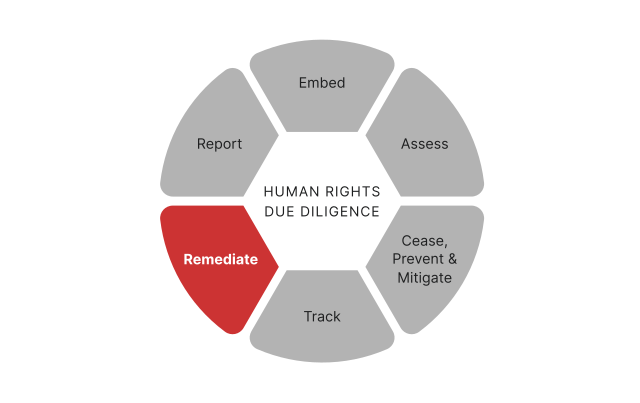
Remediation means ensuring that a human rights harm is fully resolved, the affected stakeholder is provided appropriate remedy, and that systems are improved to prevent recurrence.
Companies are expected to provide for or cooperate in remediation in situations where they have caused or contributed to a human rights harm, and/or are directly linked to that harm.


Overview
Companies must respond whenever they learn of possible human rights harms connected to their operations or supply chains.
Inaction increases harm to affected stakeholders while creating serious legal and reputational risks. When harms are confirmed, companies must ensure appropriate remedies are provided. There is no one-size-fits-all model for responding to news of a potential human rights harm; every company should develop an approach to response that suits its internal structure and ways of working. However, it is good practice for a company to develop a response protocol to guide its actions when faced with a finding of a human rights harm in its operations or supply chain. Any protocol should lay out roles and responsibilities for the various actors who are responsible for taking actions to respond to the issue.
Maturity benchmarking
Basic

The company has a response protocol in place, and relevant staff are prepared to use it. The company has communicated to suppliers their roles and responsibilities in implementing the protocol.
How to get there:
- Identify potential issues, scenarios and causes for which response and remediation could be needed
- Draft a company-level response protocol that is calibrated to different levels of control, leverage and influence within the company
- Train staff on the response protocol’s purpose, roles and responsibilities, and how to use the response protocol
- Establish data collection and handling systems that ensure documents and records are usable for tracking issue resolution and trends
- Communicate to suppliers their roles and responsibilities in the response and remedy process
Established

In addition to “Basic,” the company ensures that field staff and suppliers in its at-risk supply chains are prepared to use the response protocol, and it has provided them with relevant training. Relevant staff and suppliers are held accountable for implementing response and remedy processes.
How to get there:
- Support at-risk suppliers and field staff with tools and training on how to implement the response protocol
- Engage stakeholders in review and strengthening of response process
- Track whether the response protocol is being followed
- Establish process for holding suppliers accountable for use of response protocol and effective remediation (5.2 Remediation of Harms)
Leadership

In addition to “Established,” the company takes further steps to track and verify the implementation of response and remedy in its supply chains, including at the first mile level.
How to get there:
- Routinely evaluate response processes for effectiveness, including engaging independent third parties and other stakeholders for external review
- Reinforce expectations of suppliers to follow the company’s response protocol, as part of supplier performance reviews
- Expand scope of supplier engagement to all prioritized commodities and geographies, including at the first mile level


Overview
If a human rights harm occurs on a farm or other workplace in the supply chain, the company and/or its supplier must take prompt action to protect the affected person(s), provide remediation, and ensure that the issue does not recur.
In practice, this often happens through the creation and implementation of a Corrective Action Plan (CAP). A robust CAP should cover the steps outlined in this component’s downloadable guidance document.
In agricultural settings, determining appropriate remedies often requires local knowledge and understanding of cultural factors and other contextual causes of human rights issues. Regular stakeholder engagement with affected stakeholders is crucial to providing appropriate remedy and ensuring that root causes of human rights harms are addressed.
Maturity benchmarking
Basic
The company, working with supplier(s) as appropriate, responds to human rights harms or grievances by creating and implementing corrective action plans. Corrective action plans should include both provision of remedy to affected persons and actions to prevent recurrence of the issue.
How to get there:
- Secure necessary resources for provision of remedy
- Identify services available in the relevant geographic area (government, NGOs, other), to which affected persons can be referred if remediation is needed
- When a human rights harm is identified, create a corrective action plan detailing both remedy to the affected person(s) and prevention of recurrence
- Implement corrective action plan in the timeframes specified
Established
In addition to “Basic,” the company tracks and ensures that harms or grievances have been appropriately remediated and that steps have been taken to prevent recurrence. The company has engaged with stakeholders to understand root causes and appropriate forms of remediation and to verify that corrective actions and remedy have been effective.
How to get there:
- Follow up on cases to ensure remedy was implemented and effective
- Refer affected persons to remediation resources when needed
- Routinely do structured cross-functional root cause analysis to determine root and contributing causes
- Engage affected persons and other stakeholders for input on root causes and appropriate remedies
- Record data on individual cases, corrective actions and remediation outcomes
- Report case data internally, and to customers as required under response protocols
Leadership
In addition to “Established,” corrective action plans and remediation are effectively tracked and verified, and good performance is rewarded with incentives. The company and/or suppliers collaborate with government, civil society, and industry actors to develop or strengthen collaborative approaches to remediation and to address root causes of harms.
How to get there:
- Analyze data on cases to identify common root causes and effective practices that can be scaled
- Establish incentives for suppliers who consistently deliver effective corrective and remediation actions (1.3 Procurement Practices)
- Collaborate with peers, government, civil society, and/or multi-stakeholder initiatives and partnerships to address the more challenging systemic root causes of harms