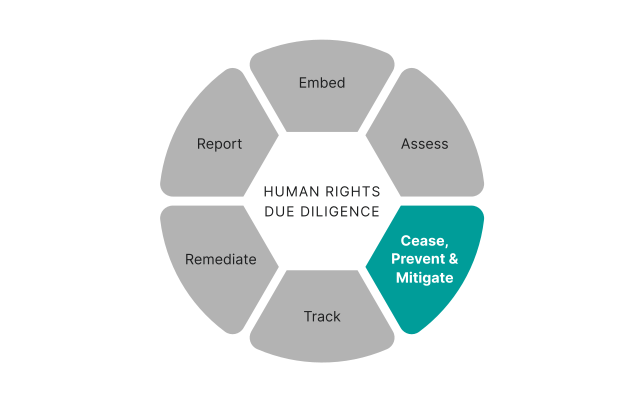
Components:
Once the company has completed an overall saliency analysis, assessed serious risks and harms in more depth, and created a human rights strategy, it is ready to take action to cease harmful practices and prevent and mitigate the identified risks and violations.

Overview
A formal human rights strategy provides a useful framework for organizing the company’s decisions about its priorities and objectives for its work on human rights.
A company’s human rights strategy should directly reflect the findings from its risk and harm assessments, prioritizing issues that are most prevalent, serious, and within the company’s responsibility to address. The strategy should cover the company’s key salient issues, state the core objectives the company seeks to achieve through its human rights program, and identify the commodities and geographies in which the company will prioritize its efforts.
Maturity benchmarking
Basic

The company uses the insights from its assessment of risks and harms to define its priorities for action and core objectives related to human rights.
How to get there:
- Use findings from supply chain mapping, saliency assessment, and in-depth assessments to develop list of prioritized issues and commodity-geography combinations
- Develop a core set of proposed objectives to guide the company’s work addressing human rights issues
- Identify HRDD processes and systems that need to be implemented or strengthened in order to meet the objectives
- Engage internal stakeholders for feedback, revising as necessary; obtain senior management endorsement of decision
Established

In addition to “Basic,” the company has a human rights strategy in place that incorporates stakeholder consultation, and it is implementing the strategy.
How to get there:
- Identify and engage with relevant stakeholders in prioritized supply chains to inform development of the company’s strategic approach
- Develop a formal human rights strategy for the company, prioritizing the objectives and laying out steps to achieve them
- Implement the strategy, beginning with the highest priority objectives, focusing on the due diligence system elements needed to achieve them
- Engage external stakeholders for feedback on the company’s human rights priorities and strategic approach to driving impact
- Secure necessary resources for ongoing implementation and strengthening of the strategy
Leadership

In addition to “Established,” the company routinely evaluates the sufficiency of its human rights strategy to drive impact and updates its priorities, objectives, and resourcing as necessary.
How to get there:
- Regularly review supplier monitoring data and other sources of information on HRDD system performance (e.g. farm monitoring data, worker grievance reports, ongoing risk assessments, etc.)
- Gradually strengthen the strategy to shift its focus from HRDD implementation to impact on salient issues, including additional commodities and geographies in scope, and deepening the company’s focus on addressing root causes of human rights risks
- Adjust the company’s HRDD resourcing to ensure the updated strategy is able to be implemented and that new or ongoing objectives can be achieved


Overview
Once the company has a human rights strategy in place, it should develop indicators and set targets to measure progress.
In the early stages of maturity, the company will likely focus primarily on process indicators and targets, measuring the implementation of its due diligence systems. As the company matures in its human rights due diligence, it should measure its impact on salient issues as well. Human rights strategies should include clear timelines for transitioning from process measurements to impact assessments. Establishing human rights indicators and targets requires a formal process with clear accountability assigned at senior leadership levels
Maturity benchmarking
Basic
The company has developed high-level key performance indicators (KPIs) to measure progress toward its human rights objectives and its impact on salient issues. It has set targets for each indicator.
How to get there:
- Review the top-level KPIs used by major customers and peer companies on human rights
- Review any mandatory human rights reporting/disclosure requirements under current or emerging laws and regulations
- Develop a draft list of high-level KPIs to measure the company’s progress on implementation of HRDD and its impact on salient issues
- For each KPI, set a numeric target and timeline that is both realistic and ambitious
- Consult with internal stakeholders to evaluate feasibility and costs associated with tracking and reporting on the proposed KPIs, and to validate the targets and timelines 6. Finalize top-level human rights KPIs and targets obtain senior-level endorsement and approval of necessary resources
Established
In addition to “Basic,” the company has built out its KPI framework to include supporting indicators and targets to drive progress on HRDD implementation and impact.
How to get there:
- Review top-level KPIs in leading voluntary frameworks and reporting initiatives; decide whether to align the company’s KPIs to these or add additional top-level KPIs
- Develop supporting indicators that measure the implementation of HRDD systems and processes in prioritized commodities and geographies (these indicators will roll up into the top-level implementation KPIs)
- Develop supporting indicators measuring the effect of intensified HRDD on salient issues in prioritized commodities and geographies (these will roll up into the top-level impact KPIs)
- For each supporting indicator, set a numeric target and timeline that is both realistic and ambitious
- Communicate indicators, targets, and data reporting requirements to suppliers in prioritized commodities and supply chains
6. Implement a process for senior management to regularly review progress against indicators and targets, and to adjust targets or dedicate additional resources to keep progress on track
Leadership
In addition to “Established,” the company actively uses impact indicators and targets to drive continual improvement in the effectiveness of its HRDD system at reducing risks and harms associated with its salient issues.
How to get there:
- Continually increase the number of suppliers, salient issues, and commodity-geography combinations covered by the company’s data reporting requirements
- Ensure progress on meeting targets is integral to the company’s overall human rights strategy (3.1 Strategy and Objectives)
- Use suppliers’ data to inform supplier engagement and procurement decision-making (1.3 Procurement Practices, 4.2 Monitoring of Suppliers)
- Increase engagement with affected stakeholders to understand and incorporate their perspectives on measuring impact
Further reading
Corporate Human Rights Benchmark Methodology: Food and Agricultural Products Sector
Develop Targets and Indicators
Indicator Design Tool
Indicator Design Tool Template


Overview
Once the company has developed its human rights strategy and defined the indicators and targets it will use to drive progress on its objectives, it is ready to develop detailed action plans.
Companies typically develop action plans for specific combinations of salient issues, commodities, and geographies—such as child labor in Côte d’Ivoire’s cocoa industry—though plans may address multiple commodities, human rights issues, or countries simultaneously.
The process of developing action plans should build upon the knowledge gained through in-depth assessments, including relevant root cause analysis. The deployment of action plans relies heavily on in-country personnel, knowledge, and resources. The company should plan to support its local teams, and/or those of its suppliers, to carry them out.
Maturity benchmarking
Basic
The company has developed action plans to implement its human rights strategy and achieve its objectives in prioritized commodities and geographies.
How to get there:
- Create company-level action plans to implement the human rights strategy, with a focus HRDD implementation or intensification in prioritized commodity-geography contexts
- Engage Tier 1 suppliers and other stakeholders in prioritized commodity-geography contexts to understand what will be required to effectively address the root causes of salient issues
- Prioritize suppliers to receive capability building and intensive engagement
- Draft country-level (or commodity-level) operational action plans for internal actions, support to suppliers, and external collaboration
- Secure budget for initial implementation activities
Established
In addition to “Basic,” the company is implementing action plans for its highest priority commodities and geographies, building awareness and capability among suppliers and other partners.
How to get there:
- Begin implementation of country-specific action plans, focusing on early-stage activities and interventions such as supplier awareness-raising, capability building, and establishing basic management systems
- For each activity and intervention, assign accountable persons, action items, timelines, resource requirements, and measures of success
- Work with company management and external partners to secure resources for plan implementation and expansion over time
- Develop action plans for additional commodity-geography combinations and suppliers in priority order
Leadership
In addition to “Established,” the company is well advanced in implementing impact-focused action plans, and it is expanding action planning to additional at-risk suppliers, commodities, and geographies.
How to get there:
- Deepen programs to improve systems and achieve impact in reducing risks and harms due to root causes, including in the first mile
- Obtain senior management commitment for sustainable funding to support ongoing programming and action plan implementation
- Document and communicate best practices identified during plan implementation to improve supplier performance
- Routinely engage affected stakeholders in the evaluation of the impact achieved by action plans to continually strengthen plans and programs
- Develop and implement action plans for all at-risk commodities and origins, and embed them within
Further reading
Protecting Children Action Plan
Focusing on Mexico: Improving Human Rights and Labor Practices


Overview
If a company’s own operations or business practices are directly causing or contributing to human rights harms, or potentially could cause or contribute to such harms, the company should cease those practices.
Addressing human rights issues may require adopting new business models or transforming existing ones. Companies might need to alter their product mix or reconsider certain business relationships and market operations, while avoiding the temptation to simply withdraw from high-risk countries. Progress on human rights requires engagement with governments, civil society, and industry peers to address underlying drivers of risk wherever possible. In the long run, sustained engagement is necessary to create safe and fair agricultural workplaces and value chains.
Maturity benchmarking
Basic
The company has examined its business practices to determine if any are contributing to human rights risks and harms, and it has prioritized improvement actions.
How to get there:
- Examine how the company procures from its Tier 1 suppliers to determine if those practices impact its suppliers’ ability to meet legal requirements and the company’s code of conduct
- Develop a prioritized list of actions to improve procurement practices; discuss them internally and with key suppliers
- Pilot test at least the highest priority action and gather data to measure the feasibility and impact of the change
Established
In addition to “Basic,” the company has secured senior management endorsement and buy-in from affected departments, and it has implemented changes to business practices that had been causing or contributing to human rights harms.
How to get there:
- Continue to pilot test actions to improve procurement and other business practices
- Work internally to build understanding and buy-in on prioritized actions
- Make relevant teams/departments accountable for implementing improved practices within their control
- Where change in practices means terminating business relationships with certain suppliers or sourcing in certain origins, assess possible harm to workers and other affected stakeholders caused by the change and take steps to minimize harm
- Broadly phase-in additional prioritized actions proven feasible and effective by pilot testing
Leadership
In addition to “Established,” the company routinely reviews and revises business practices that cause or contribute to human rights risks and harms, and it implements additional practices that have direct positive impacts on farmers and workers.
How to get there:
- Senior management/Board of Directors routinely evaluate the impact of procurement practices on reducing human rights risks and harms, and approve changes to facilitate progress
- Design and implement procurement practices, such as supplier incentives and direct sourcing, whose positive impact on farmers and workers can be measured (1.3 Procurement Practices)
- Senior management/Board of Directors approve strategic changes in company practices in support of human rights objective
Further reading
Addressing the Retention of Identity Documents
Red Flag 19. Sourcing Commodities That Are Priced Independent of Farmer Income
True Price website
Business Model Red Flags: 24 Ways in Which Businesses Could be Wired to Put People at Risk


Overview
Capability building for suppliers is often an important enabler of human rights due diligence and should be included in most human rights strategies and action plans.
Many suppliers will need help to develop or improve their internal human rights-related systems and processes, adjust their business practices, better track and report data, and reduce the drivers of human rights risks or harms. Capability building for suppliers often implies formal training, but it can also include other kinds of programmatic investments. These include awareness-raising and consulting support to design and implement monitoring systems, manage risks, remediate harms identified, and track progress.
Maturity benchmarking
Basic
The company has conducted an assessment across its supplier base and uses it to prioritize specific groups of suppliers for training and to identify learning objectives for each group. It has begun providing basic-level training to some suppliers.
How to get there:
- Prioritize supplier companies and key target groups within those companies
- Develop training/capability building plans for each type of target group, including topics, desired outcomes, format, frequency, and budget
- Internally, or with support from an external partner, develop training materials and begin delivering training to prioritized target groups, including pre- and post-training surveys to measure learning
Established
In addition to “Basic,” the company is building the skills and capabilities of key suppliers, enabling them to implement effective human rights due diligence of their own operations and supply chains.
How to get there:
- Expand the training provided to prioritized suppliers to cover implementation of effective due diligence systems
- Expand the reach of training to include more suppliers in prioritized geographies and commodities
- Track training participation, learning, and outcomes to enable continual improvement of the supplier capability building program
Leadership
In addition to “Established,” the company is building the capabilities of suppliers in all priority commodities and geographies, enabling suppliers to self-manage human rights risks and harms. Training is updated as needed to reflect supplier performance challenges and changes in risk profiles and regulatory requirements.
How to get there:
- Deliver routine refresher training on key topics
- Expand training to cover suppliers’ identified human and labor rights challenges
- Routinely evaluate the impact of training onparticipant behavior and on achieving risk and harm reduction; adjust training as needed
- Measure the long-term impact of supplier training in terms of behavior change (e.g., how are participants applying learning to their work)
Further reading
Guidance on Communication and Training Across the Supply Chain by Verité’s COFFEE Project


Overview
Within first mile operations, there are many target groups that can benefit from training and capability building.
Examples include the operations’ own staff, the service providers they work with (e.g. labor providers or providers of services such as crop spraying), agronomists or buying agents who visit farms on a regular basis, the farmers who sell to the operation, farm workers, and others. Training and awareness-raising programs in the first mile should be appropriate to stakeholders’ linguistic, cultural, and educational backgrounds, and to local levels of access to technology. Any training or awareness raising program should be respectful of the time constraints faced by trainees, especially during labor-intensive phases of agricultural cycles.
Maturity benchmarking
Basic
As part of its supplier assessment process, the company has identified the first mile operations in its supply chain that are most in need of capability building, and set key learning objectives for those operations. It has developed training plans and begun rolling out training to some first mile operations.
How to get there:
- Identify first mile operations in need of capacity building support
- Identify key staff or target groups within those first mile operations
- Develop training plans and materials tailored to target audiences, or work with an external partner to do so
- Deliver (or have partner deliver) trainings, and survey participants on learnings
Established
In addition to “Basic,” the company (and/or its supplier) continues to train first mile operations, building their capacity to implement effective human rights due diligence in their own operations and supply chains.
How to get there:
- Expand the training provided to prioritized first mile operations to cover implementation of effective due diligence systems in their operations and supply chains
- Expand the reach of training to include more first mile operations in prioritized geographies and commodities
- Track training participation, learning, and outcomes to enable continual improvement of the supplier capability building program
Leadership
In addition to “Established,” the target audience for training extends beyond first mile operations to other actors in the first mile, such as farmers who supply to the first mile operation, labor recruiters, and farm workers. Capability building also continues for first mile operations, with training curricula updated as needed.
How to get there:
- Continue to expand the reach of training to additional first mile operations in order to enable self-management of salient issue risks and harms
- Routinely evaluate the impact of training on participant behavior and in achieving risk and harm reduction
- Use data to improve training effectiveness and drive HRDD improvements
- Develop and implement training plans for new target audiences in the first mile 5. Ensure budget for ongoing training programs
Further reading
OFI 2022 Coffee Lens Impact Report
Work Safely in the Heat (poster)
Prevent Heat Illness at Work (poster)
Open-Source Training Modules developed by Verité’s COFFEE Project
Verité Fair Hiring Toolkit – Step 6. Multi-Stakeholder & Multi-Brand Engagement
Verité Fair Hiring Toolkit – Step 7. Public Policy Advocacy
Better Cotton
Bonsucro
Ethical Tea Partnership
Equitable Food Initiative
Fairtrade International
International Cocoa Initiative
Rainforest Alliance
Roundtable on Sustainable Palm Oil
Sustainable Rice Platform
AIM-Progress
Consumer Goods Forum
Ethical Trading Initiative
Fair Labor Association
Leadership Group for Responsible Recruitment


Overview
Companies rarely achieve human rights objectives alone. This is because business operations span diverse geographic, political, institutional, social, economic, and cultural contexts, with root causes of human rights risks typically extending beyond any single company’s control.
Companies can collaborate with partners across the private sector, government, and/or civil society. Forms of collaboration include public-private partnerships, multi-stakeholder groups, industry-specific initiatives, industry-led platforms and associations, and landscape approaches, among others. Together with partners, companies should explore collective ways to address common human rights risks, and design interventions that align different stakeholders’ actions to complement and support one another. This is particularly important when working on landscape- or country-level root cause issues that drive risk for all companies, not just in one supply chain.
Maturity benchmarking
Basic
Based on its assessments and supplier evaluations, the company has identified which human rights risks and supplier related risks it has the leverage to address by itself, and which will require collaboration, such as through multi-stakeholder initiatives, industry groups, or government engagement.
How to get there:
- Identify which priority suppliers the company does not have sufficient leverage with to directly address human rights risk prevention and mitigation
- Identify other customers of low leverage suppliers for possible collaboration
- Identify key forums or opportunities for collaboration
- If gaps exist, consider initiating new collaborations
Established
In addition to “Basic,” the company has identified collaborations that will help it achieve its human rights objectives, and it has started engaging with the relevant partners and/or joining existing initiatives.
How to get there:
- Identify staff responsible for engaging in collaborative initiatives at the headquarters level and in sourcing origins, and equip and empower them to speak on behalf of the company
- Participate actively in selected collaborative initiatives
- Ensure sufficient internal support (dedicated time, budget, commitments, etc.) for meaningful participation
- Communicate about involvement in collaborative initiatives to drive participation by others and support from company leadership
Leadership
In addition to “Established,” the company is an active member of one or more collaborative initiative(s) and commits funds and resources to ensuring their success.
How to get there:
- Continue to dedicate financial and human resources to participation
- Team members take up key decision-making positions and are active in shaping strategy
- Continually assess the outcomes of collaborative initiatives and push for greater impact