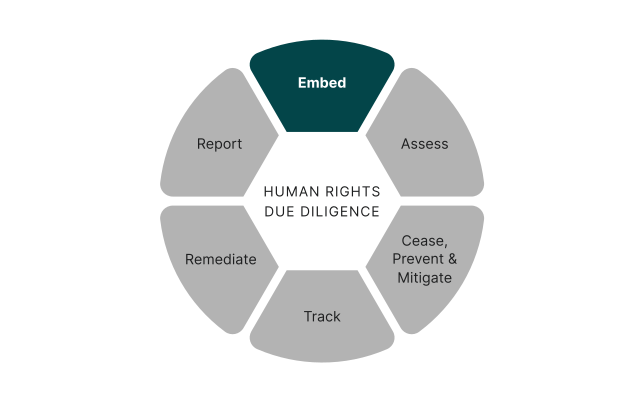
Components:
Embedding human rights into a company’s management systems means making human rights an integral part of the company’s business culture and day-to-day operations, similar to other core business priorities such as efficiency, quality, cost, and environmental sustainability.
Further reading
Embedding Respect for Human Rights: United Nations Guiding Principles Reporting Framework


Overview
A company’s commitment to respect human rights should start with a public statement of policy explaining how the company understands its responsibilities.
The policy should set clear performance expectations (standards) for those who are expected to adhere to or implement it, such as the company’s own workforce, its suppliers, and other business partners. Scope of the human rights policy should ultimately reach all the way to the first mile of agricultural supply chains.
A formal supplier code of conduct is often used to convey expectations to Tier 1 suppliers, but standards should be cascaded by those suppliers to lower tiers as well. Policies for specific human rights issues such as child labor or forced labor, or for specific commodities or sectors, may also be useful tools for articulating priorities and driving progress.
Maturity benchmarking
Basic

The company has a policy that includes commitments to respect human rights and comply with international labor standards and local laws, and it has communicated the policy to its suppliers through a code of conduct.
How to get there:
- Assign someone to lead policy development
- Form a cross-functional team to gather information and draft policy
- Review peer and customer policies and codes of conduct, along with any human rights commitments already made by the company
- Draft the policy and code of conduct, incorporating input from a sampling of key external stakeholders such as major customers and Tier 1 suppliers
- Secure buy-in and sign-off from senior leadership
- Communicate the policy and code of conduct to internal staff, customers, Tier 1 suppliers, and other relevant external stakeholders
Established

In addition to “Basic,” the company fully aligns its existing human rights policy and code of conduct with customer and industry good practices, and it adds an explicit commitment to doing human rights due diligence (HRDD).
How to get there:
- Benchmark the company’s policy and code against customer requirements and industry best practices, and strengthen as needed
- Add an explicit commitment to doing HRDD
- Add a requirement that suppliers do HRDD in their own supply chains, including at the first mile level
- Communicate updated policies and requirements to Tier 1 suppliers
- Engage actively with Tier 1 suppliers to ensure that policy requirements are understood
Leadership

In addition to “Established,” the company works with suppliers to ensure they understand how to implement requirements in practice, and it engages stakeholders in the policy updating process.
How to get there:
- Develop and communicate improvement pathways for suppliers corresponding to each policy requirement, including measurable standards where possible
- Engage relevant internal and external stakeholders in periodic review of the policy and code of conduct, and revise as necessary
Further reading
A Guide for Business: How to Develop a Human Rights Policy
2021 Fair Food Program Report (Appendix C: Code of Conduct)
Guiding Principles on Business and Human Rights
Nestlé Supplier Portal
Starbucks’ Suppliers webpage
Sample Code of Conduct Provisions for Food and Beverage Supply Chains
Sample Code of Conduct Provisions by Verité’s COFFEE project


Overview
Companies should establish governance and oversight processes for human rights performance similar to those used for other core business strategies to ensure policies are upheld in practice.
Senior leadership should assume formal accountability for human rights performance to ensure human rights are prioritized and embedded within corporate culture.
Executive managers should send clear messages about the company’s human rights commitments to staff across the organization and empower procurement staff and others to convey expectations to suppliers whose practices affect human rights. Executive performance should be evaluated and compensated partly based on the company’s human rights performance, following the principle that “what gets measured gets done.”
Maturity benchmarking
Basic
The company has assigned accountability for human rights performance to a senior executive and/or the Board of Directors.
How to get there:
- Assign someone to lead policy development
- Form a cross-functional team to gather information and draft policy
- Review peer and customer policies and codes of conduct, along with any human rights commitments already made by the company
- Draft the policy and code of conduct, incorporating input from a sampling of key external stakeholders such as major customers and Tier 1 suppliers
- Secure buy-in and sign-off from senior leadership
- Communicate the policy and code of conduct to internal staff, customers, Tier 1 suppliers, and other relevant external stakeholders
Established
In addition to “Basic,” review of the company’s human rights performance is a routine activity for executive leadership and the Board. Responsible managers and relevant functional staff are evaluated on their performance in implementing the human rights policy
How to get there:
- Establish an annual review of company human rights performance by executive management and the Board of Directors
- Include human rights implementation roles in relevant executive, manager, and functional staff (e.g., procurement) position plans and job descriptions
- Include achievement of human rights policy commitments in the performance evaluations of relevant executives, managers, and functional staff
Leadership
In addition to “Established,” the company makes human rights performance an integral part of its executive and Board compensation schemes, and it ensures that other elements of executive compensation, such as total shareholder return, do not incentivize decisions that compromise human rights.
How to get there:
- Include the company’s human rights performance in calculations of executive management variable compensation
- Ensure management performance incentives reinforce achievement of human rights policy commitments
- Ensure that performance incentives for procurement executives are tied to supplier human rights performance
Further reading
CEO Guide to Human Rights
Human Rights Due Diligence and Corporate Governance
Leadership and Governance Indicators of a Rights Respecting Culture
Linking Executive Compensation to ESG Performance


Overview
The way a company procures products and services should support—not hinder—a supplier’s ability to meet human rights requirements.
Once a company has stated its policy commitments to human rights, it should begin to align its procurement practices with those commitments. This means:
- Ensuring human rights performance standards are reflected in supplier contracts and purchase agreements
- Sourcing from suppliers and contractors that are committed to meeting the company’s policy requirements
- Providing incentives to suppliers for meeting performance standards and disincentives for those falling short.
Rewards and recognition for procurement staff should not incentivize behaviors that could undermine suppliers’ ability to respect human rights.
Maturity benchmarking
Basic
The company has human rights requirements that are clearly and consistently communicated to suppliers in contracts and purchase agreements, and procurement staff understand the requirements and know how to apply them.
How to get there:
- Include a requirement to conform to the company’s human rights policy, code of conduct and performance standards in contracts and purchase agreements
- Ensure procurement staff are familiar with the policy and standards for suppliers
- Develop procedures to help procurement staff incorporate a supplier’s commitment and ability to meet the company’s code of conduct into buying decisions whenever possible
- In supply chains where the company does not do direct on-farm monitoring related to human rights issues, purchase products certified or audited under robust, credible schemes
Established
In addition to “Basic,” the company is actively addressing existing procurement practices that disincentivize human rights performance. The company’s procurement function has systematically integrated supplier human rights performance into its decision-making.
How to get there:
- Identify and change any existing procurement practices that disincentivize procurement staff from achieving the company’s human rights policy objectives or send suppliers mixed signals
- Change sourcing practices that adversely impact a supplier’s ability to comply with labor and human rights laws and policy and code of conduct requirements
- Factor performance on human rights into evaluations of existing suppliers
- Screen prospective suppliers in advance for human rights risks and their ability to manage them
- Begin transitioning to longer term and more direct sourcing relationships with suppliers who have demonstrated good performance on human rights and traceability
- If purchasing products certified or audited under third-party schemes, shift volumes to those with the most robust coverage of human rights and traceability, where possible
Leadership
In addition to “Established,” the company routinely evaluates the impact of its procurement practices on the human rights performance of its suppliers, including first-mile farmers. It uses that information to improve its procurement practices and supplier incentives and to measure the performance of its procurement staff.
How to get there:
- Ensure suppliers are incentivized to drive human rights performance
- Incentivize farmers to respect human rights
- Phase out sourcing from auctions or suppliers with no ability to trace products to their source
- Factor in supplier human rights compliance in evaluating procurement staff performance
- Regularly review procurement practices and revise as needed to ensure they foster the desired behaviors in procurement staff and good human rights performance among suppliers
Further reading

Common Framework for Responsible Purchasing Practices in Food.
Contractual Clauses Project
Good Purchasing Practices
How We’re Partnering Suppliers to Build a More Equitable Society
Pre-Sourcing Human Rights Due Diligence
Agriculture Supply Chain Principles for Responsible Sourcing (Principle 2: Responsible Sourcing and Procurement)
Sample Social Responsibility Agreement for Food and Beverage Supply Chains
The Five Principles of Responsible Purchasing


Overview
Companies should establish a dedicated team to carry out day-to-day human rights due diligence work, in addition to maintaining executive- and board-level accountability.
Human rights due diligence staff typically work within legal or sustainability departments, though they may also operate from procurement or other business units. Companies sourcing significant volumes of key commodities from specific countries should place human rights personnel within those regional or country teams.
Human rights teams must be sufficiently staffed and trained, with the necessary resources to support the company’s human rights objectives. Companies may need to invest in data systems to effectively support human rights due diligence oversight.
Maturity benchmarking
Basic
The company has a human rights team in place with clear roles and responsibilities. The team is developing information systems to record and track HRDD-related data, and it is connecting with other business units about HRDD implementation.
How to get there:
- Secure internal buy-in and resources for setting up or expanding a human rights team/function
- Establish clear team roles and responsibilities
- Design and roll out training to enable human rights team members to be successful in their roles
- Identify staff in other business units whose roles intersect with HRDD
- Utilize the organization’s existing IT systems or develop or obtain new ones to record and track HRDD related data and information
Established
In addition to “Basic,” the company continues to build the capability of its human rights team and relevant business units to support HRDD implementation, including data systems.
How to get there:
- Invest in growing the capacity and capabilities of the human rights team/function as needed, both at the enterprise level and in at-risk sourcing regions
- Provide training to staff in other relevant business functions on HRDD implementation and on collecting and reporting HRDD data
- Institutionalize training programs for existing and new staff, both in the human rights team and in other units
- Track learning outcomes from trainings on an ongoing basis, including how training participants apply what they have learned in their work
Leadership
In addition to “Established,” the company has committed to maintaining a human rights team that can manage its HRDD system indefinitely, including in key sourcing countries. The company’s HRDD information systems are fully functioning and can provide actionable data on human rights performance.
How to get there:
- Continue to train and build the capacity of human rights team members, particularly in key sourcing countries
- Consider designating human rights leads for key commodities
- Maintain and continually improve HRDD information management systems