By Shawn MacDonald, CEO, Verité
& Mary Tanagho Ross, VP Programs, Bet Tzedek Legal Services and Founder, Bet Tzedek Anti-Trafficking Initiative
Originally published by the Business & Human Rights Centre
Amid heightened immigration enforcement in the United States, businesses may be tempted to turn a blind eye to the mistreatment of workers without legal status in their supply chain. This temptation has been reinforced by a marked reduction in federal enforcement of workers’ rights, alongside successful efforts in at least 17 states to loosen labour protections, including by weakening child labour laws.
This tension can create confusion about whether companies should still be concerned about the treatment and rights of workers who are not US citizens. It shouldn’t. Companies are still legally obligated to respect the rights of all workers – not only because it is the right thing to do, but because legal obligations and business risk have not diminished.
Businesses cannot function when the rule of law is suspended. Local commerce depends on trust. Trust that … constitutional rights will be upheld.
American Sustainable Business Network
The rule of law and why it matters for business
The American Sustainable Business Network wrote: “Businesses cannot function when the rule of law is suspended. Local commerce depends on trust. Trust that … constitutional rights will be upheld.” When that trust shatters, workers fear showing up. Customers stay home. Commerce stops.
A stable, predictable operating environment depends on consistent enforcement of laws, including labour laws. Businesses must therefore comply with existing federal and state laws guaranteeing all workers – regardless of immigration status – core labour protections, including protection from forced labour and other exploitative employment practices. Workers without immigration status, especially in low-wage industries like construction, food processing and manufacturing face disproportionately high rates of wage theft, human trafficking and other forms of exploitation.
Even where government enforcement may shift, NGOs, private attorneys and state-level actors continue to investigate cases of labour abuse. Workers themselves are still coming forward, as evidenced by the noted cases below.
Recent cases demonstrate that companies and intermediaries can be held accountable regardless of workers’ immigration status:
- JBS USA Food Company (Dec. 2025): Haitian migrant workers sued JBS USA Food Company for allegedly luring them with promises of well-paid jobs at a meatpacking plant in Colorado. They were instead charged to live in squalid conditions and forced to work in dangerous conditions. (Pierre v. JBS USA Food Company).
- Hyundai supply chain litigation (Nov. 2025): The complaint alleges that Hyundai exploited migrant workers, including children, in its supply chain. The lawsuit invokes the Unfair Competition Law in California to hold the corporation and its affiliates accountable for child labour, forced labour and related violations. (Jobs to Move America v. Hyundai Motor America, et al).
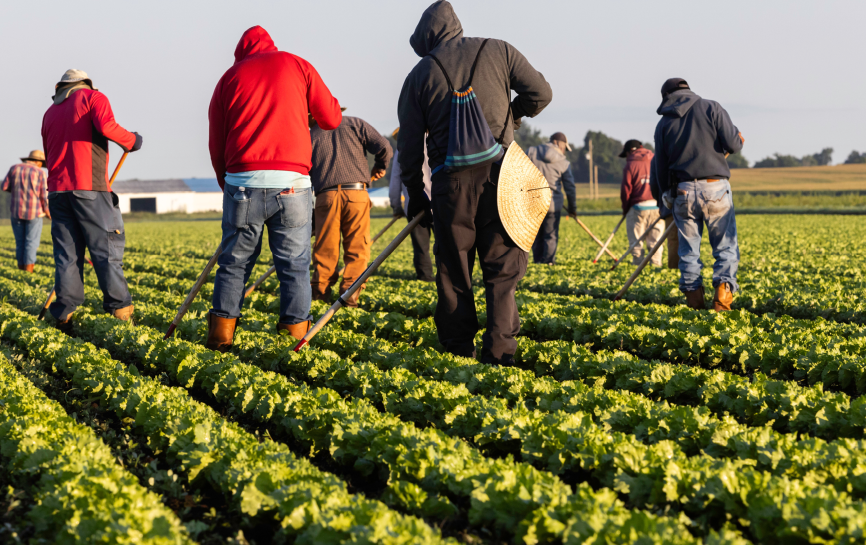
Agricultural workers weed fields at sunrise on a large farm.
In addition to civil lawsuits, companies may face criminal enforcement actions for labour abuses regardless of workers’ immigration status. Recent examples include:
- California wage theft prosecution: The San Diego County District Attorney’s Office recently announced human trafficking and wage theft charges against two defendants who managed residential care facilities for the elderly. The defendants are accused of “leveraging [workers’] immigration status as a weapon of exploitation” and forcing them to work around the clock without the required pay.
- Civil enforcement: In 2024, California labour authorities cited 19 car washes in Los Angeles County and Orange County for $1.3 million in wage theft violations impacting nearly 1,000 affected workers.
- Federal H-2A visa fraud indictment: In February 2026, the Department of Justice indicted individuals for fraudulently obtaining 103 temporary work visas under the H-2A program by falsely claiming they worked for Marquez Farms LLC. They recruited workers from Mexico under false promises of providing a job with adequate conditions at Marquez Farms LLC.
Why risk increases when companies look away
During a time when hundreds of thousands of workers all over the US – regardless of citizenship or working status – face the risk of detention, arrest, deportation and extreme violence at the hands of Immigration and Customs Enforcement (ICE) agents, companies may assume that the best course of action is to keep a low profile. They may be tempted to halt due diligence activities or neglect compliance with labour laws for workers who may be undocumented or have temporary work status. In reality, the opposite is true: risk increases when companies fail to monitor labour conditions and recruitment practices.
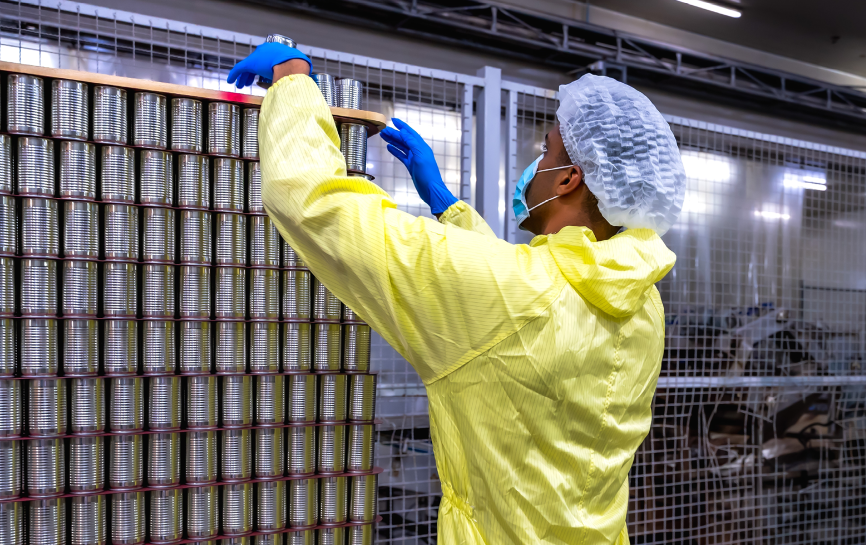
A food processing worker prepares canned foods for shipment.
How immigration crackdowns fuel labour shortages and vulnerability
US companies have already experienced severe labour shortages, and with immigration crackdowns, those labour shortages are only going to get worse. This is not only an issue for undocumented workers, but also for legally authorised workers in the US, including asylees, Temporary Protected Status holders, and even permanent residents.
Immigration crackdowns can push workers further underground, increasing reliance on third-party labour recruiters and labour brokers, farm labour contractors, and temp agencies. Outsourcing workers or recruitment through labor brokers can create significant legal and reputational risks for companies. These recruitment channels are often linked to illegal practices such as charging recruitment fees, deceiving workers about their working conditions, and retaining their identity documents and earnings, all of which are indicators of forced labour.
During times of labour shortages, companies meet their labour needs by turning to workforces which are at higher risk of abuse, including children, temporary and undocumented workers, and prison labor.
In times of uncertainty, the rule of law is not a constraint on business, it is what makes business possible.
What companies should do
It is critical that companies carry out in-depth assessments throughout their supply chains to identify labor risks affecting migrant workers. If undocumented workers are identified, companies should not respond by disengaging with the supplier or explicitly or tacitly encouraging termination. Instead, they should work with suppliers to ensure workers’ rights are respected and provide all workers with access to legal and support resources during this time of well-founded fear of authorities engaging in racial and other forms of profiling.
Importantly, immigration status should not determine how companies assess or respond to labour conditions. All workers have the same fundamental labour rights. By ensuring these steps, companies play a direct role in upholding labour protections and the rule of law on which stable commerce depends.
In times of uncertainty, the rule of law is not a constraint on business, it is what makes business possible. Respecting labour protections for all workers – regardless of immigration status – is not only required by law, it is essential for reinforcing the systems of stability and accountability on which businesses rely.
About the Authors

Shawn MacDonald is a leading expert in labor and human rights policy, with more than 25 years of experience advising multinational companies, governments, and international institutions in labor rights and multisector partnerships.
As CEO of Verité since 2016, he guides the organization’s global mission to eradicate the most severe labor and human rights abuses in global supply chains. Shawn joined Verité in 2003 when he led the organization’s research, program development, and policy initiatives before becoming CEO. His work has shaped policy approaches to forced labor prevention and legal enforcement frameworks across multiple government administrations.
 Mary Tanagho Ross serves as Vice President of Programs at Bet Tzedek Legal Services, leading strategy and impact for legal programs serving over 65,000 children and families a in need each year. Mary has spent her career advocating for the rights of children and youth and survivors of human trafficking and forced labor. She has represented survivors of exploitation domestically and internationally. Mary leads the organization’s Anti-Trafficking Initiative which serves survivors of forced labor and human trafficking by connecting them with vital legal services, while combating human trafficking through policy advocacy and impact litigation. She trains and provides technical assistance to litigation teams representing survivors in federal civil claims and through other avenues of relief.
Migrant workers, Construction, United States, Food processing