As seen in the April 2026 issue of Tea & Coffee Trade Journal
By Quinn Kepes, Senior Regional Lead, Americas
In recent years, forced labor import bans have moved from policy debates to reality, and enforcement has ramped up in a number of sectors, including coffee. For many coffee companies, that shift arrived fast, before they were ready to deal with the consequences.
There is a growing wave of forced labor import bans; the United States, the European Union, Canada, and Mexico have already passed laws prohibiting the import of goods produced with forced labor. Meanwhile, Argentina, Australia, Bangladesh, Cambodia, Ecuador, El Salvador, Guatemala, Indonesia, South Korea, Malaysia, North Macedonia, Taiwan, and the UK are in the process of developing or strengthening such legislation.
In February 2026, U.S. Customs and Border Protection (CBP) issued a Withhold Release Orders (WRO) against coffee from a Mexican farm, immediately blocking imports from that supplier. This was the first WRO in the coffee sector, and it sent a clear signal that coffee is now within the scope of forced labor enforcement. Since the U.S. has begun including provisions in bilateral trade agreements requiring partner countries, including Guatemala and Bangladesh, to recognize and enforce its WROs, this could have ripple effects across the globe.
The implications for companies are significant.
First, import bans create severe commercial risks. Shipments of goods produced with forced labor can be detained at the border. For coffee traders, roasters, and brands operating on tight delivery schedules, retentions of shipments can lead to supply chain disruptions, lost sales, damaged client relationships, and significant compliance costs.
Second, enforcement risk is often difficult for companies to anticipate. Many coffee companies rely heavily on desk-based risk screenings that draw on publicly available information. But in the coffee sector, these screenings rely on how well-documented forced labor is in a country, not the actual level of prevalence or severity. Countries that have strong labor inspections and an active civil society and press that investigate and report on forced labor are often assessed as riskier. However, Verité field research has found that the opposite is true; risks are often far higher in countries with a lack of documentation of forced labor risks and institutional capacity and company actions to address the issue. This creates a dangerous blind spot and misinformed company investments in due diligence efforts in lower-risk countries.
Coffee is produced through highly fragmented supply chains involving millions of farms and seasonal workers. Harvest seasons require rapid labor recruitment of migrant workers, often through informal labor brokers, and workers are often paid piece rates, creating vulnerabilities to forced labor. In this environment, traditional compliance approaches are insufficient. Regulators increasingly expect companies to demonstrate robust human rights due diligence systems, including mapping supply chains beyond the first tier, identifying where labor risks are most salient, and establishing credible processes to prevent and remediate harms.
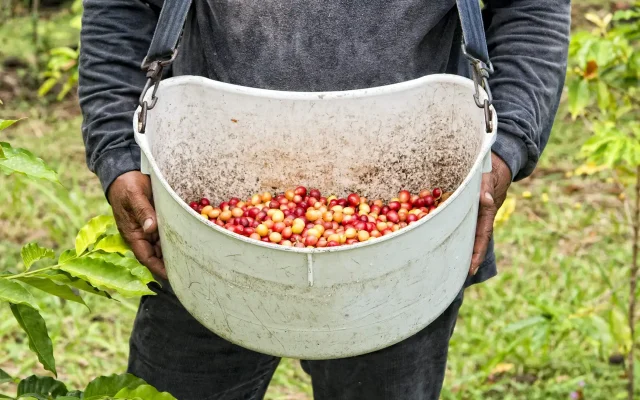
Worker-informed, field-based assessments are critical for identifying hidden risks
Importantly, it also requires going beyond desk research. Worker-informed, field-based assessments are critical for identifying hidden risks. Conducting in-depth, off-site interviews with workers often reveals forced labor risks that do not appear in public reports but could very well trigger enforcement actions.
Beyond just identifying risks, companies must also rethink how they engage suppliers. Addressing forced labor requires collaboration across the supply chain, from farm-level capacity building to revisions of procurement policies. It is essential to implement cost-effective solutions to address the main drivers of forced labor and provide tools and assistance to farmers, the supply chain actors with the least resources to invest in remediation.
Conducting in-depth, off-site interviews with workers often reveals forced labor risks that do not appear in public reports, but could very well trigger enforcement actions.
Quinn Kepes
For coffee companies, the regulatory message is clear: forced labor risks must be effectively identified and addressed across the supply chain, especially at the farm level. This is essential for maintaining market access, protecting brand reputation, and ensuring that the coffee reaching consumers is produced under safe and fair working conditions.
The companies that invest now in meaningful human rights due diligence will be far better positioned as enforcement continues to expand.
This article was originally published in the April 2026 issue of the Tea & Coffee Trade Journal
About the author
 Quinn Kepes is the Senior Regional Lead for the Americas at Verité, where he works with companies, governments, and civil society to address forced labor and other human and labor rights risks in global supply chains. He has more than 20 years of experience leading research, projects, and Human Rights Due Diligence, including over 15 years working to address forced labor risks in the coffee sector.
Brazil, Brasil