Verité’s Farm Labor Due Diligence Toolkit in Action in the West African Cocoa Sector
As many practitioners have found, the theory of human rights due diligence may look straightforward on paper, but putting it into practice is a complicated, creative, continuous process – and one that is crucialto ensuring respect for the people behind every chocolate bar, bowl of chocolate ice cream, and cup of hot cocoa.
With support from the Swiss Agency for Development Cooperation and in collaboration with a global agricultural trading company,Veritéput due diligence theory to the test by applying the Farm Labor Due Diligence Toolkit to the company’s operations and cocoa supply chains.
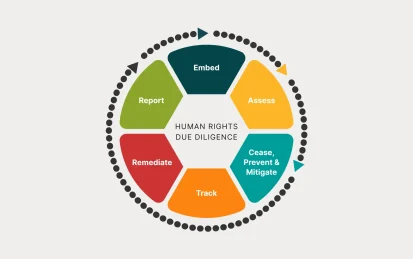
Verité’s Farm Labor Due Diligence (FLDD) Toolkit is a free, comprehensive guide to due diligence for companies that source agricultural ingredients through global supply chains. Launched in 2024, the Toolkit has become a go-to resource for retailers of food and beverage products, agricultural commodity traders, and firstmile operations such as farms, mills, and cooperatives, for managing the complex web of activities that constitute human rights due diligence.
Verité’s partnership with the company focused on a critical human rights challenge: migrant workers in West African cocoa-growing regions face high risks of forced labor on farms. Along with child labor, this represents one of the most salient human rights risks for companies sourcing cocoa. To address this risk, this partnership has yielded practical resources and real-world insights that other companies can apply to their own supply chains.
Targeted Tools for the Enterprise Level

Beginning at the company’s enterprise level, Verité applied Element 1 (Embed) of the FLDD Toolkit to understand how the company has embedded human rights into its business operations globally. Verité also examined how the company assesses risks across global operations and trains its employees on how to identify and assess human rights issues in their everyday work, particularly in the company’s cocoa sourcing business section (applying Element 2: Assess of the Toolkit).
Through this process, Verité identified specific gaps in existing due diligence practices and developed targeted resources to address them. Although these enterprise tools were developed in the context of cocoa sourcing, businesses can apply them to their broader human rights work.
Sample code of conduct provisions and auditable standards:
Companies can strengthen their supplier codes and auditable standards by integrating targeted language that specifically addresses forced labor risks facing migrant workers. This tool provides ready-to-use provisions that companies can adapt and integrate into their existing auditable standards or codes.
Simplified supplier screening tool for agricultural traders:
Companies managing thousands of suppliers of varying sizes and sophistication levels can use this streamlined screening tool to efficiently assess human rights risks among new suppliers without overwhelming smaller operations.
Case study on an agricultural trader’s forced labor survey tool:
Organizations looking to strengthen their forced labor identification and response capabilities can learn from the company’s approach to identifying and assessing risks in its cocoa supply chains.
E-Learning module that prepares field teams to identify and respond to forced labor risks in agriculture:
Companies can enhance their teams’ practical skills using this e-learning training material designed specifically for sustainability managers and field staff who need to recognize and respond to forced labor risks in agricultural settings.
Taking HRDD to the First Mile in Ghana and Côte d’Ivoire
Verité also collaborated closely with the company at the first mile level. The company selected two cocoa farmer organizations from their supply chain-a farmer association in Ghana and a cooperative in Côte d’Ivoire-where Verité’s field staff worked with these organizations and the company’s field staff to implement the FLDD First Mile Toolkit.
Tools for First Mile Supply Chain Actors

To accurately assess the farmer organizations’ current understandings, policies, practices, and staff capabilities in areas of ‘Embed’ and ‘Asses’, Verité developed targeted questionnaires (see below). These questionnaires can be used by farmer organizations as a self-assessment tool or by cocoa buyers and suppliers to understand the HRDD practices of the cooperatives they buy from.
The Assessment Questionnaire for Farmer Organization Leadership is the primary tool to collect information about the farmer organization’s business practices for each component. To validate the responses to the primary questionnaire and better understand where there are gaps between policy and practice, Verité also developed accompanying questionnaires to collect related information from other key stakeholders, including field staff, farmer members, and farm workers.
Embedding Human Rights in First Mile Operations
Primary Questionnaire:
- Assessment Questionnaire for Farmer Organization Leadership (English | French)
- Questionnaire Administration Guidance and Response Interpretation for Farmer Organization Leadership Tool (English | French)
Accompanying questionnaire:
In-Depth Assessment of Risks & Harms
Primary questionnaire:
Accompanying questionnaires:
- Assessment Questionnaire for Farmer Organizations Intermediaries (English | French)
- Assessment Questionnaire for Farmer Members and Farm Workers (English | French)
Practical Resources to Strengthen First Mile HRDD Practices

As part of the first mile engagement, Verité worked closely with the farmer organizations and the company to develop resources that addressed some of the HRDD gaps identified through the assessment process. A couple of these are:
Sample human rights policy for a cooperative (English | French):
Farmer organizations seeking to establish clear human rights expectations for themselves and the farms in their service area can use this resource as a basis to form their own human rights policy.
Simple guidance on conducting human rights risk assessments for cocoa cooperatives and farmer organizations (English | French):
Farmer organizations that wish start to identify and assess the human rights risks in their service area or wish to improve their current approach can use this resource to understand general good practices for conducting human rights risk assessments.
3 Practical Ways to Advance Your HRDD Today
Does your company want to learn more about how to implement HRDD from your corporate headquarters all the way down to the farms where your commodities are grown? Here are a few ways to get started:
- Learn where your company’s current HRDD practices stand through Verité’s interactive FLDD Benchmarking Assessment Tool
- Explore the FLDD First Mile Toolkit for detailed guidance and action steps for implementing HRDD in first mile operations.
- Get in touch with us about how we can partner with your company to build stronger, more effective HRDD systems.
Acknowledgments
Verité is grateful to have received financial support from the Swiss Agency for Development and Cooperation (SDC) of the Federal Department of Foreign Affairs (FDFA) through the Protecting Migrant Workers in the Cocoa Sector of Cote d’Ivoire and Ghana project to develop and pilot the Embed and Assess elements of Verité’s Farm Labor Due Diligence (FLDD) Toolkit and First Mile Toolkit in the West African cocoa sector.