
In the following article, under the Cooperation On Fair, Free, Equitable Employment (COFFEE) project, Verité’s Quinn Kepes and Miguel Zamora make the case for win-win solutions in the form of scalable cost-effective models to improve working conditions for coffee harvesters while also benefitting farmers. The article is the last in a series of seven articles on labor issues in the coffee sector for Daily Coffee News by Roast Magazine, the largest coffee industry publication.
The COFFEE Project, which is supported by a grant from the U.S. Department of Labor, originates from Verité’s research and experience in identifying high levels of forced labor, child labor, and wage, hour, and health and safety violations in coffee-producing countries. Although there are several emerging regulatory requirements and increased consumer and buyer expectations related to labor conditions, there is a lack of concrete, useable resources to guide coffee producers and other supply chain actors. The COFFEE Project addresses the need for practical resources, tools, and training materials tailored to coffee producers in origin to effectively identify, address, and prevent labor issues in the coffee sector. It also includes pilot projects in Brazil, Mexico, and Colombia, where Verité piloted approaches to improve workers’ wages and wellbeing through the COFFEE Project and conducted a living wage and living income study with funding from Keurig Dr Pepper.
The following is an article excerpt from Daily Coffee News by Roast Magazine.
Promoting Living Wages for Farmworkers While Ensuring Farmers Earn a Living Income
In this article, we highlight the need for coffee roasters, traders and retailers to provide farmers with the support necessary to effectively implement these recommendations through the provision of living incomes and living wages. The improvement of labor conditions in the coffee sector is the responsibility of every actor in the supply chain, not just farmers.
As coffee companies increasingly work towards promoting living wages for workers across their supply chains, it is important to emphasize that farmers who are earning less than a living income will find it difficult to pay their workers a living wage.
On the flip side, simply increasing coffee prices to guarantee farmers a living income does not necessarily lead to a living wage workers, as the trickle-down economics principle has been proven to be as ineffective in rural contexts as it has been in the United States.
Therefore, coffee companies should work with farmers in their supply chains, both to ensure that they are earning a living income and to incentivize and monitor the payment of living wages to workers.
Another option is to implement systems to provide premiums or services directly to workers in order to improve their incomes and wellbeing. Fortunately, there is a variety of living income and living wage studies, as well as cost-effective solutions at the farm level that coffee farmers and companies can implement to improve workers’ incomes and wellbeing.
An Example from Colombia
Verité, in partnership with the Anker Research Institute, recently published a living income and living wage report for rural areas in Central Colombia, including Colombia’s famed eje cafetero (coffee axis).
The study provides living income and living wage benchmarks, both for the COFFEE pilot project in Colombia, as well as for the Colombian coffee sector more broadly.
The Colombia pilot project seeks to improve workers’ incomes and wellbeing through cost-effective alternative and complimentary compensation approaches that do not create an economic burden on farmers, especially smallholders who often earn less than the living income.
Instead, the project seeks to create shared value for both workers and farmers by increasing worker incomes, wellbeing, satisfaction, retention, and productivity.
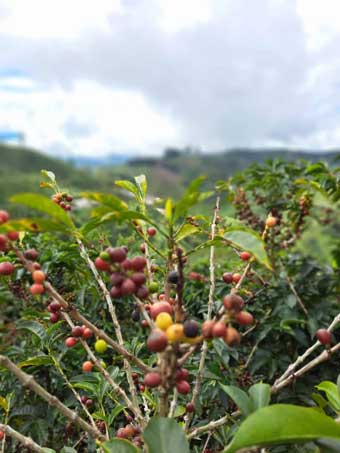
Coffee cherries ripening on the tree
The report revealed that the living wage in the region is about 50% higher than the Colombian minimum wage. Although coffee harvesters may earn close to a living wage during the harvest season, many workers depend on the income generated during the harvest to support their families for the whole year. This is an important distinction for the coffee sector, as only about 5% of coffee workers are permanent workers with access to year-round incomes, social protection and benefits.
Recognizing that piece-rate payment is a common and risky practice in the coffee sector, Verité’s COFFEE Project is piloting alternative payment approaches and documenting the effects of worker wellbeing programs, in partnership with the socially responsible coffee trader RGC Coffee and its Manos del Café project, as well as its local partner, the Salgar Coffee Growers’ Cooperative.
The project conducted workshops and interviews with workers and coffee farmers to gather their input and preferences regarding alternative payment models, complementary compensation schemes and worker wellbeing programs. Based on worker input suggesting an almost equal preference for increased wages and worker wellbeing programs, the COFFEE project piloted and evaluated a range of different interventions to determine their effects and opportunities for scaling and replication.
One of the interventions involved the use of specialized harvesting tools such as lonas (plastic sheeting) and canguaros (webbed gloves) to improve worker productivity and incomes without increasing working hours or the level of exertion. These tools decreased ergonomic risks for workers while helping to control pests and diseases for farmers.
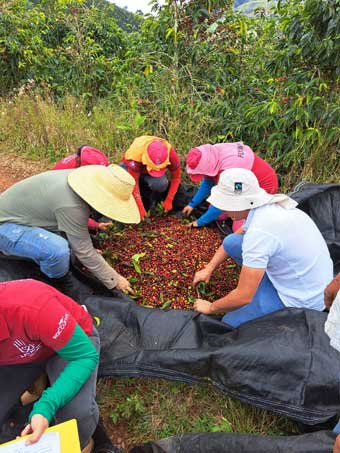
Workers use lonas (plastic sheeting) to sort out leaves from freshly picked coffee cherries. Photo credit: Verité
Verité documented important lessons learned, such as the fact that lonas are more effective during the peak harvest, while canguaros work better during the off-peak season. In addition, the use of lonas proved to be especially effective in increasing women’s productivity, resulting in a reduction in the productivity gap between men and women — which is often related to women having to perform unremunerated work, reducing the time they can spend harvesting coffee.
While there are some challenges in scaling up usage, including small initial investments and training, such tools present a potential win-win solution for workers and farmers.
See the full article published in Daily Coffee News by Roast Magazine.