Editorial
18 August 2023
Editorial
18 August 2023
Search results
Showing results 141-150 of 406 for "forced_labor/page/35/_gravityform_id=4/page/11/page/13/page/14/page/15/page/16/page/14/page/15/page/14/page/15/page/17/page/16/page/31/page/11/page/13/"
Editorial
18 August 2023
Despite ‘No Fees to Workers’ Policies, Workers Are Still Paying
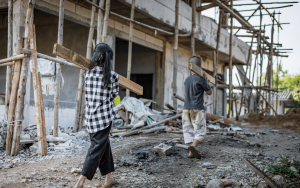
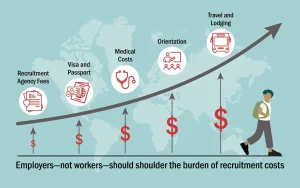
Verite’s analysis of thousands of recent recruitment transactions between employers and labor recruiters in high-risk labor migration corridors into the Southeast Asia, Middle East, and Gulf Cooperation Council regions finds that fewer than 10% of employers are recruiting workers ethically by paying the full cost of recruitment and preventing workers from being charged for their job.
 Update
7 April 2025
Update
7 April 2025
Message from Our CEO, Shawn MacDonald: Standing Firm in Challenging Times
We find ourselves in increasingly volatile and challenging times for human rights and labor rights globally, with hard-won protections facing new challenges every day. Now, we face a critical and systematic dismantling of worker protections: the elimination of the U.S. Department of Labor's Bureau of International Labor Affairs (ILAB) programs through deliberate, far-reaching cuts. This devastating action destroys decades of progress by gutting 69 essential programs—representing more than $500 million—that fought child labor, forced labor, and other labor abuses across 40 countries.
 Editorial
12 April 2023
Editorial
12 April 2023
Guidance for Companies on Understanding the Distribution of Child Labor Risk in the United States
A widely-read New York Times article on child labor by unaccompanied child migrants, published in February 2023, detailed the way that young people fleeing economic and political crises in Central America have collided with the tight US labor market and inadequate US labor law enforcement to create a “perfect storm” for child exploitation in the United States.

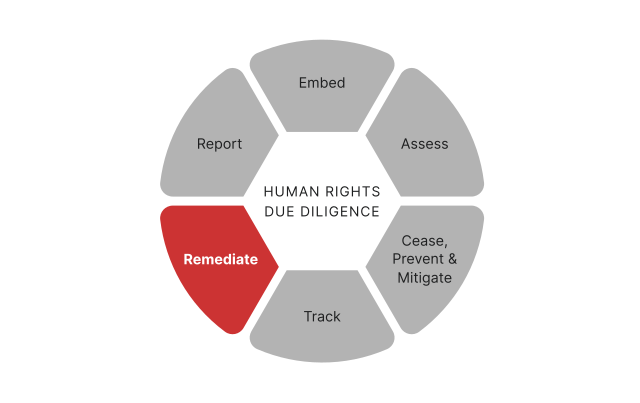
Remediate
Remediation means ensuring that a human rights harm is fully resolved, the affected stakeholder is provided appropriate remedy, and that systems are improved to prevent recurrence.
 Update
21 June 2022
Update
21 June 2022
Employer Pays Verification
Debt bondage, due to the imposition of recruitment fees and costs on foreign migrant workers, remains the most pervasive and entrenched form of forced labor in global supply chains today. Reimbursement is an important remedy but, on its own, it is not a solution to the underlying root causes of this ongoing labor abuse.
 Editorial
11 April 2025
Editorial
11 April 2025
Coalition Corner - The Latest on Advocacy Advancements
Working through coalitions is an indispensable part of Verité’s advocacy efforts to influence policy changes that uplift and safeguard the rights and well-being of workers worldwide. Today, Verité’s coalition work involves bringing expertise and knowledge on supply chains and labor rights to the policy arena so that public policy is informed and ultimately enforceable. The following resources and news highlight the latest advancements with our coalition partners.
 Update
24 October 2022
Update
24 October 2022
How to Conduct Effective Forced Labor Due Diligence at Scale?
Social audits have proven to be ineffective in detecting and preventing debt bonded labor, the most pervasive and entrenched form of forced labor in global supply chains today. While deep dive, focused, worker-centric investigations of the type conducted by Verité and like-minded organizations, are the gold standard to detect and remedy these abuses, it is neither practical nor cost effective for buyers, investors, and other stakeholders to use this approach at every workplace in high-risk countries, sectors, supply chain tiers, or migration corridors.
 Update
1 October 2020
Update
1 October 2020
U.S. Department of Labor Releases 2020 List of Goods Produced by Child Labor or Forced Labor
Few reports have as much significance in the world of labor rights as the bi-annual U.S. Department of Labor’s List of Goods Produced by Child Labor or Forced Labor, the latest edition of which was released on September 30.
 Update
19 December 2022
Update
19 December 2022
Addressing Forced Labor Risk in West African Cocoa
In 2022, Verité continued its leadership role on the issue of forced labor in the West African cocoa industry, implementing trainings for cocoa suppliers on identifying and addressing forced labor, and supporting cocoa companies to develop response protocols to help them respond promptly and effectively when indicators of forced labor are found.
 Editorial
12 May 2023
Editorial
12 May 2023
Urgent Action Needed to Protect Children From Labor Exploitation
As organizations working to address human trafficking and labor exploitation, we are appalled by the horrific conditions children experienced after fleeing to the United States for refuge. This series in the New York Times demonstrates our government’s inability, unwillingness, or outright refusal to protect minors from forced labor.