Search results
Showing results 211-220 of 406 for "forced_labor/page/34/_gravityform_id=4/page/30/page/20/page/50/page/47/page/20/page/19/page/30/page/10/page/12/page/13/page/14/page/13/page/11/page/40/page/50/page/51/page/20/page/21/"
Palm oil
Palm oil production, a global staple, is associated with forced labor, child labor, and trafficking in several producing countries. Workers often face hazardous conditions, including long hours, low wages, and exposure to harmful chemicals. The industry is characterized by complex supply chains, with palm oil produced on large plantations and smallholder farms. Certifications like the...

Gold
Gold mining is closely tied to forced labor, child labor, and trafficking, especially in informal and artisanal operations. In countries like Burkina Faso, Mali, and Peru, miners often face hazardous conditions, including exposure to mercury and cyanide. Informal recruitment practices, criminal control, and smuggling further entrench exploitation. Despite its high value and portability, gold is...

Kenya
Kenya’s large informal labor force and regional instability strain protections and raise trafficking risks across key supply chains. As a lower-middle-income country, agriculture remains the largest employer, though over 15 million workers (out of 18 million) are in the informal sector, where enforcement of labor protections is weak. Conflict and refugee movement from neighboring states...

The Gambia
Ongoing economic fragility and weak labor protections in The Gambia expose vulnerable groups to trafficking risks across informal sectors. As a low-income country with limited economic diversification, The Gambia relies heavily on groundnuts (about 80% of agricultural revenue), remittances, and tourism, while over 75% of workers are in the informal economy. The 2022 U.S. Trafficking in Persons...

 Update
19 December 2022
Update
19 December 2022
Corruption, Recruitment, and Forced Labor E-Course
With support from Humanity United, Verité launched a new, free, interactive, e-learning course that explores how public corruption in the foreign worker recruitment process renders migrant workers vulnerable to debt bondage: "Nice Products: A Story of Corruption, Recruitment, and Forced Labor."

 Webinar
1 January 2024
Webinar
1 January 2024
Forced Labor Risks in Construction Supply Chains
The construction industry, with its reliance on low-skilled, low-pay manual jobs often filled by migrants, has long faced significant forced labor risks globally. We’ll discuss these risks, the challenges of monitoring the sector’s long and complicated supply chains and how our new due diligence tools set can help. Customized to the sector, the tools are one feature of our fully refreshed ResponsibelSourcingTool.org (RST), which has been updated and expanded with the support of the U.S. Department of State’s Office to Monitor and Combat Trafficking in Persons.

Rachel Rigby
Rachel has 20+ years of experience driving social impact and best-practice Human Rights Due Diligence (HRDD) in global supply chains. She has deep knowledge of international labor and human rights standards, guidance, and metrics in agriculture, and a strong track record of collaborating across cultures and building international and multi-stakeholder partnerships. As a Senior Director,...

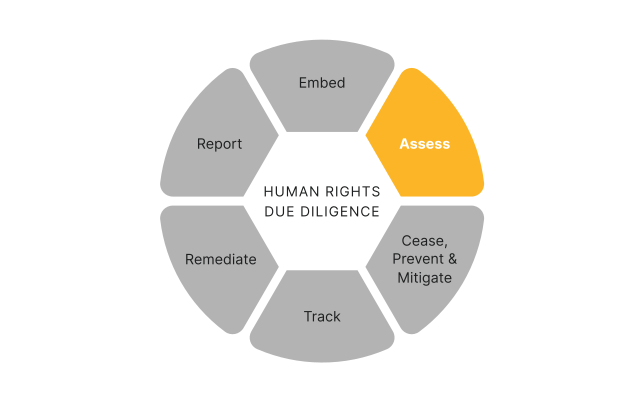
Assess
The “Assess” element refers to the processes by which companies take stock of human rights risks and harms caused by their operations and those of their supply chain partners.
 Editorial
15 October 2024
Editorial
15 October 2024
Engaging Driver Unions through Cross-Border Collaboration in Ghana and Côte d'Ivoire
Building on the 2016 joint declaration between Ghana and Côte d'Ivoire to combat human trafficking and child labor, Verité’s Forced Labor Indicators Project (FLIP) is strengthening collaboration between these two West African nations. Since 2018 in Ghana, and 2021 in Côte d'Ivoire, Verité has fostered coalition-building through Technical Working Groups (TWGs), uniting diverse stakeholders to raise awareness of forced labor and human trafficking, influence policies, and drive national-level change through collaborative expertise.
 Editorial
11 February 2026
Editorial
11 February 2026
Does Training Workers Reduce Forced Labor Risk? Why Systems and Sequencing Matter
As forced labor enforcement expands and human rights due diligence expectations rise, many companies are investing more heavily in training and capacity building across their supply chains. But a critical question remains: what kind of training has the biggest impact?
