Search results
Showing results 111-120 of 406 for "forced_labor/page/22/_gravityform_id=4/page/5/page/21/page/20/page/41/page/10/"
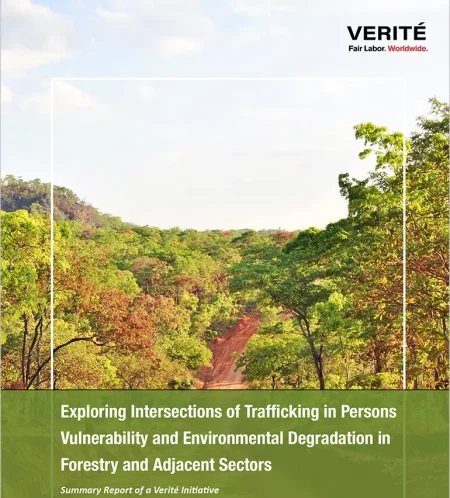
Exploring Intersections of Trafficking in Persons Vulnerability and Environmental Degradation in Forestry and Adjacent Sectors
A global study exploring how deforestation and environmental harm intersect with labor exploitation, revealing shared risks to people and planet across forest-linked industries. Drawing on case studies from Mozambique and Burma, this research uncovers how deforestation, corruption, and poverty converge to heighten vulnerability to forced labor and trafficking. In forestry, road construction, and agribusiness, communities...
Interactive Self-Assessment Benchmarking Tool (Farm Labor Due Diligence)
Part of the Farm Labor Due Diligence initiative, this interactive self-assessment tool helps companies understand where they stand in building fair and responsible farm labor systems. Through a confidential 12-question survey, it offers a simple entry point into the due diligence process, providing tailored feedback on current performance and practical next steps for improvement. Designed...

What is child labor in the coffee farming sector?
This video explains what child labor is and what coffee producers can do to recognize, prevent, and eliminate it. It was developed for the COFFEE Project and is part of the COFFEE Project Toolkit, which focuses on creating a virtuous cycle of continuous improvement to address labor risks in company supply chains.

Child labor risks in the coffee farming sector
This video explains why agricultural work is hazardous for children and the physical risks of child labor. It was developed for the COFFEE Project and is part of the COFFEE Project Toolkit, which focuses on creating a virtuous cycle of continuous improvement to address labor risks in company supply chains.

E-learning for Agri-Suppliers: Identifying and Responding to Forced Labor in Agriculture
This course is a training for the in-country sustainability teams and field teams of agricultural traders and suppliers. It was developed for the West African context, but its principles are broadly applicable to agricultural production in other geographies. This course is designed to be taken by country-level sustainability managers and team members. Learnings from the...
Sample Agency Agreement Clauses to Mitigate Recruitment-Related Risk
A practical reference guide offering sample contract clauses to help employers and suppliers embed ethical recruitment standards in their agreements. This resource provides model clauses that employers can adapt to prevent recruitment-related exploitation in their supply chains. Based on real agency contracts, it covers key areas such as payment terms, recruiter accountability, and worker protection...

Introducing the Supply Chain Traceability Matrix
Do you have questions about traceability in supply chains? Are you interested in learning about how traceability can support labor due diligence? This webinar introduced the Supply Chain Traceability Matrix, a free resource developed by Verite’s Supply Chain Tracing and Engagement Methodologies (STREAMS) Project for leveraging traceability to support labor rights in global supply chains....

Responsible Sourcing in the Transportation Sector
In this webinar, hosted by Verité and supported by the U.S. Department of Transportation, discover new tools for identifying and managing forced labor risks across transportation supply chains. This essential webinar introduces sector-specific risk analysis frameworks and due diligence tools from ResponsibleSourcingTool.org. This webinar is for public and private transportation entities, government contractors, supply chain...

Caja de herramientas para implementar la contratación equitativa en el sector agrícola en México
A practical toolkit to help agricultural producers in Mexico adopt fair recruitment and employment practices that protect workers’ rights and strengthen responsible supply chains. This collection of eight guidance documents provides a step-by-step framework for fair recruitment and ethical employment in the agricultural sector. Drawing on international labor standards and Mexico’s legal framework, it offers...
Migrant labor in the Argentinian garment industry: Deceitful recruitment, indebtnedess and precarity
For years, migrant workers have provided a constant labor supply for garment workshops in Argentina. Now, these workers are moving to home-based garment production, where precarity and vulnerability continue.
