Rubber, a vital global raw material, is frequently tied to forced and child labor in several producing countries.
Production methods span large plantations and smallholder farms, but the labor-intensiveness—especially the tapping of rubber trees—exposes workers to hazards like skin and eye injuries, snakebites, acid exposure, heavy lifting, and back strain. Layers of middlemen and batch‑mixing during processing further obscure origins, while low global rubber prices disproportionately affect small producers and erode labor standards.
- Burma (FL, CL)
- Cambodia (CL)
- Côte d’Ivoire (FL)
- Indonesia (CL)
- Liberia (FL, CL)
- Philippines (CL)
- Vietnam (CL)
- Thailand
- Indonesia
- Vietnam
- India
- China
- Malaysia
- Cote d’Ivoire
- Philippines
- Guatemala
- Burma
Source: FAOSTAT 2017 (https://www.fao.org/faostat/en/#data/QC)
- Thailand
- Indonesia
- Vietnam
- Malaysia
- Côte d’Ivoire
- Burma
- Belgium
- Lao People’s Democratic Republic
- Guatemala
- Liberia
Source: International Trade Center (ITC Calculations based on UNCOMTRADE Statistics). https://www.intracen.org/
- China
- United States
- Malaysia
- Japan
- India
- Republic of Korea
- Germany
- Brazil
- Turkey
- Spain
Source: Source: International Trade Center (ITC Calculations based on UNCOMTRADE Statistics). https://www.intracen.org/
Where is rubber reportedly produced with trafficking and/or child labor?
According to the U.S. Department of State 2018 Trafficking in Persons Report, rubber is produced with forced labor or forced child labor in Burma, Côte d’Ivoire and Liberia.[1]
The 2018 List of Goods Produced by Forced Labor and Child Labor, published by the U.S. Department of Labor (DOL), notes that natural rubber is produced with forced labor in Burma. In addition, natural rubber is produced with child labor in Burma, Cambodia, Indonesia, Liberia, the Philippines, and Vietnam.[2]
The U.S. Department of State 2018 Trafficking in Persons Report lists the Philippines as a Tier 1 country. Cambodia, Indonesia, Vietnam, and Côte d’Ivoire are listed as Tier 2 countries. Liberia is listed is a Tier 2 Watch List country. Burma is a Tier 3 country.[3]
What does trafficking and/or child labor in rubber production look like?
Indicators of forced labor and exploitive labor conditions have been documented on rubber plantations in numerous countries. Workers may experience long working hours, physically demanding and hazardous work, wage deductions, penalties for failing to meet quotas of number of rubber trees tapped, and sub-standard living conditions.
According to the U.S. Department of State in 2018, men and boys are trafficked onto rubber plantations in Burma.[4] Radio Free Asia (RFA) reported in 2015 that indicators of forced labor were present in Burma among the Rohingya, the country’s Muslim minority population. RFA reported that the Rohingya were vulnerable to both sex and labor trafficking in the Rakhine state, writing “locals have used dubious tactics to trick men into forced labor on palm oil and rubber plantations.”[5] In 2016, a development organization in Thailand reported that a Burmese woman had been trafficked onto an isolated Thai rubber plantation where she worked long hours without pay.[6]
On Malaysian rubber plantations the Fair Rubber Association found labor rights abuses including a lack of freedom of association and permanent contracts. Investigations also found discriminatory practices in the treatment of migrant workers on rubber plantations with reports of document retention, subminimum wages, lower wages than national workers, and lack of necessary safety equipment.[7] The Indonesian Rubber Research Institute (IRRI) investigated rubber tapping wages and found vulnerabilities that may contribute to forced labor risk, including earnings far below the legal minimum wage.[8] It is estimated that the monthly income of smallholders, who produce approximately 90 percent of Indonesian natural rubber, is 57 percent less than the average minimum wage in Indonesia.[9]
Verité research documented potential indicators of forced labor on two foreign-owned rubber plantations in Liberia (LAC and Cocopa), and the U.S. Department of State has reported that workers from within Liberia are trafficked on to rubber plantations.[10] On rubber plantations, the majority of workers are employed as tappers who manually extract rubber from the trees and transport it to field stations. Tappers are paid by productivity and have a quota of how many trees they must tap per day. Those who do not reach the quota are subject to financial penalties. Additionally, wages may vary from month to month as paycheck deductions are made for services such as compulsory, subsidized bags of rice, school fees, and voluntary savings programs. Workers at both plantations on which Verité conducted research are required to work eight hours per day, but twelve-hour work days are not uncommon. Researchers found that although the LAC plantation gave out loans to its employees, indebtedness was not a factor in keeping workers on the plantation. Some evidence of menace of penalty was found, such as forced dismissal, but these accounts were unsubstantiated. On both the plantations, child labor was observed. Because of the quota system, many families employ their children in order to reach the daily quota. Additionally, because of the poor quality of education and high school fees, many parents prefer to have their children work on the plantation rather than attend school. Researchers found that plantation workers, including children, face significant health risks. Working as a tapper requires hard physical labor and back pain is a common complaint. The rate of accident is high as workers have to handle machetes, hot rubber, and acid (which is used in the production process). Although protective gear is issued to most workers, not all are educated on its functionality.[11]
Historically, labor rights abuses on Firestone plantations in Liberia have been the most reported on labor rights abuses in rubber production. In 2011, a collective bargaining agreement provided for lower quotas and higher wages for Firestone workers.[12] A report from Fair Rubber Association found that sanitation facilities and housing on rubber plantations in Liberia needed improvement and identified poor health and safety standards, as well as a lack of monitoring.[13] Despite these findings, Firestone does provide significant social services to plantation workers, including schools and health care centers.[14] In 2017, due to a decrease in rubber prices, Firestone reduced its work force by an estimate of 7 percent.[15] According to the Firestone Agricultural Workers Union of Liberia (FAWUL), these layoffs were in violation of the collective bargaining agreement.[16] In August 2018, a group of Liberian Unions including the Agriculture Agro-Processing and Industrial Workers Union of Liberia, the Golden Veroleum Oil Plantation, and the Sigma group of companies demanded “living wages, better housing, safe drinking water, access to electricity, and an end to discrimination and unfair labour practices” on Firestone-owned rubber plantations.[17] In March 2019, Firestone announced that it would be laying off 13 percent of its workforce (approximately 800 Liberian employees).[18]
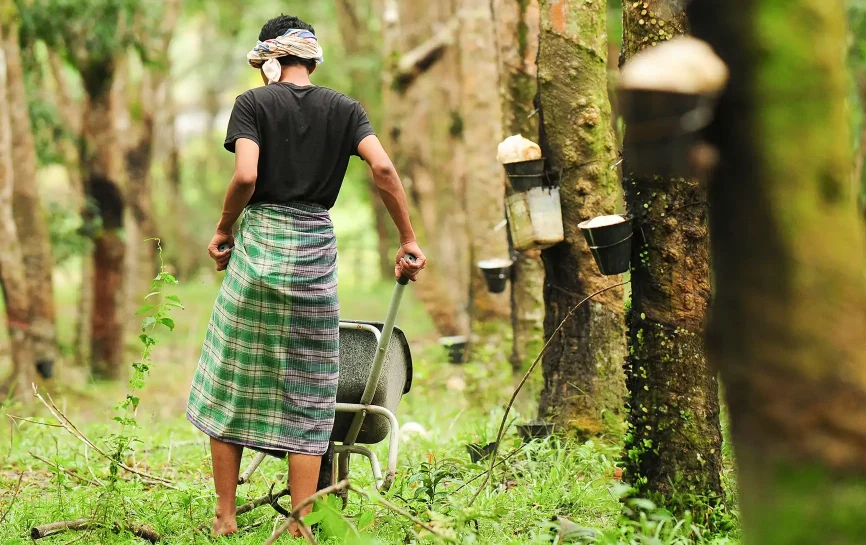
Child labor in rubber is often hazardous, as the tasks require significant physical effort. An ILO study on child labor in Indonesia found that it was not uncommon for children to help parents work on rubber plantations after school. However, if parents could not afford school fees, then children would drop out of school to work on the rubber plantation full time. Children working on the plantation are responsible for the same tasks as adults, including tapping the trees, cutting grass around the trees, spraying pesticides on weeds and fungus, and planting seedlings. Children working full time worked the same hours as adults. These children are exposed to hazards such as snake attacks, pesticides, long hours, and injury from sharp tools, with most work performed in isolated locations.[19] The U.S. Department of Labor noted that, in Liberia, children are tasked with tapping rubber trees, clearing brush and carrying buckets, again exposing them to serious workplace hazards and injuries.[20] A 2016 DOL report found that in Vietnam there is evidence that children as young as five years old are working in rubber cultivation. A study published by the Vietnamese Government estimated that 10,224 children were involved in rubber production, 42.5 percent of whom were under the age of fifteen, the legal age of employment in Vietnam. Approximately 22 percent of these children were 5-11 years old, 20 percent were 12 to 14 years old, and 57.5 percent were 15 to 17 years old. This survey defines a child as involved in child labor if the child works “an excessive number of hours per week for his or her age” or if the child is working in conditions or circumstances prohibited for underage employees by law.[21]
Research conducted by Public Radio International found that indigenous populations have been displaced from their ancestral lands in Laos, Burma, and Cambodia to make room for rubber plantations.[22] In 2013, Global Witness reported that land grabs for rubber plantations in Laos and Cambodia were displacing local populations.[23] Similarly, in 2014, Global Witness noted that the government of Burma was allocating land traditionally used by farmers for smallholder rubber production to the growth of large-scale commercial rubber plantations.[24] In 2015 it was reported that military and government actors colluded with investors to improperly seize land from ethnic minority groups.[25] Parts of forests throughout India, Vietnam, southern China, and Indonesia have been cleared to make room for rubber tree farms, resulting in environmental impacts and further threatening endangered species in the regions.[26]
Rubber production and supply chain
Rubber can be grown on large plantations or on small family farms. The production of natural rubber revolves around the life cycle of the tree from which the rubber (or latex) originates. This means that the production process for rubber requires three major stages: planting and maintaining the trees, harvesting the rubber from them by tapping, and processing the rubber for trade. As a production process, this is extremely labor intensive. In each stage, several specific tasks are involved, and each relates to the life cycle of the tree. The rubber tree is fragile, particularly in the period immediately after planting and up to when it reaches maturity at seven or eight years of age. The tree can be tapped carefully from the age of two or three, but its prime years of production, if well maintained, are from seven to 25 years.[27]
The lifecycle of a rubber field is therefore defined by three distinct phases. First, as seedlings, the trees are in a nursery, while a field is being prepared for them. When the seedlings are ready, these young trees are transplanted to the prepared field. Second, for seven to eight years, apart from periodic gentle tapping, the main activity on the field is pruning and weeding. Third, after this seven to eight-year period, the trees are ready for full production. At this stage, they will be tapped all year round. However, the peak periods of the season last from the heavy rains of May to September and the lighter rains of October to January. Production is considerably lower in the dry period lasting from February to April.[28]
The clearing of land, breeding in the nursery, and the weeding and pruning of fields and young trees are integral elements to the production process. The most labor-intensive stage, however, is the tapping of trees. This involves each tree being “tapped” with a cup that is attached to it just below a cut made in the tree’s bark to collect the latex. In a normal working day, tappers will collect “cup-lumps” from the previous day – that is, the latex that has poured into the cup overnight – then clean the cup and return to collect the new latex later that same day. At the end of the day (or alternately after a whole field has been cleared), the tapper will carry both the fresh latex and cup-lumps to the nearest field station for weighing. At the field station, acid is added to the latex as the first step in producing rubber. At this stage, there are safety concerns for workers involved in the collection and production process, with injuries in the field including eye and skin damage from spilling latex, snakebites, back pain and muscle cramps from carrying heavy loads to the field stations, and exposure to the acid that is added to the latex at the field station.[29] After the latex is mixed with acid, it is processed into sheets of latex that are dried.[30]
According to a USAID description of the rubber sector in Indonesia, small holders generally sell their rubber to nearby plantations or middlemen, while plantations sell on the open market or through traders. Traders in the value chain finance producers and provide transport. Processors buy material from collectors, plantations or famer groups. Large plantations may also be processors. Brokers collect rubber from processors and provide it to global rubber manufacturers.[31] The origin of rubber can be obscured, particularly at the broker or manufacturing level.
Today’s rubber industry is largely dependent on the mixing of batches of rubber. Natural rubber, fillers, and other compounding ingredients are mixed using a two-roll mill or other types of mixers to create “rubber compounds,” which are then sent out for mass consumption. These rubber compounds are processed further through molding machines, vulcanization units, and various curing processes. The process of compounding and curing rubber for consumer use requires a constant supply of natural rubber.[32] However, this process of compounding and altering natural rubber greatly affects its traceability within supply chains.
In 2017, the top three countries producing natural rubber were Thailand, Indonesia, and Vietnam.[33] As of 2018, the value of articles of rubber that Liberia exported to the United States of America was more than twice the value of articles of rubber sent to any other country.[34]
The Fair Rubber Association reports that the fluctuating and falling prices of natural rubber in the global economy has greatly disadvantaged small or artisanal rubber producers and deemphasized worker rights and safe working conditions.[35] While demand for rubber has slumped in recent years, newer analysis suggests that demand will potentially usurp supply, particularly if the low petroleum prices that have driven use of synthetic rubber rise.[36]
How do trafficking and/or child labor in rubber production affect me?
Because rubber is elastic, waterproof, and a natural insulator, it has a wide variety of consumer and industrial uses. Rubber is a key ingredient in automotive tires, and the automotive sector also uses rubber in belts, hoses, and seals. Natural rubber is also used for gloves, mats, condoms, hot water bottles, and protective clothing.[37]
Demand for synthetic rubber increased drastically during World War II. Today the majority of all rubber used is produced synthetically. While manufactured goods may use either natural or synthetic rubber, approximately 60 percent of all-natural rubber use is in tires and other automobile parts.[38]
Examples of what governments, corporations, and others are doing
The Sustainable Natural Rubber Initiatives (SNR-i) of the International Research Study Group and the multi-stakeholder partnership Smallholder Acceleration through Responsible Production and Sourcing (SHARP) focus on both the environmental and social impacts of rubber production, including livelihoods, food security, wages, labor conditions, land grabs, and other environmental degradation.[39]
In recent years, automakers have taken steps towards responsible rubber sourcing in their supply chains. In 2017, General Motors announced plans to move towards a more ethical natural rubber supply chain, with a focus on decreasing deforestation and increasing farmer livelihoods.[40] In 2016, Michelin, the world’s larger purchaser of natural rubber, announced a “Zero Deforestation Policy.” This policy announcement comes in the wake of Michelin’s collaboration with the World Wildlife Fund, which began in 2015.[41] In 2016, BMW and Toyota Motor Corporation committed to responsible rubber sourcing. The World Wildlife Fund reports that eight tire makers have also released responsible sourcing policies in partnership with the fund.[42]
On October 25, 2018 stakeholders launched the Global Platform for Sustainable Natural Rubber, an independent platform designed to “lead improvements in the socio-economic and environmental performance of the natural rubber value chain.” The platform includes tire manufactures and other end users, suppliers, processors, vehicle manufactures, and NGOs. The platform was conceived by the World Business Council for Sustainable Development Tire Industry Project. One of the platform’s goals is to “improve respect for human rights [and] prevent land-grabbing and deforestation” in natural rubber production and processing.[43]
The Fair Rubber Association was founded in 2012 to advance the living and working conditions of rubber producers and workers globally. This multi-stakeholder project has several members who pay a Fair Trade premium to their suppliers for every kilogram of rubber they purchase. Those who meet these qualifications can use the Fair Rubber logo in their operations. The Association notes that “supplier partners themselves decided what they want to do with the Fair Trade premium” as long as they comply with the association’s criteria list. Projects that have resulted from this Fair Trade premium include the first private supplementary pension fund for rubber plantation workers in India, supplying 64 families with clean drinking water and 21 families with electricity in Sri Lanka, and the expansion of rubber processing centers within a small farmer association in Sri Lanka, resulting in more employment opportunities for local farmers.[44]
In 2010, USAID developed the “Rubber Industry Master Plan 2010 – 2040: A National Agenda for Rubber Sector Development” in collaboration with the Liberian Ministry of Agriculture. The master plan sets up the Rubber Development Fund Incorporated (RDFI), a joint public-private organization that will implement all master plan strategies. In addition to plans to revitalize development of the Liberian rubber sector, the plan calls for improved standard of living for workers and educational access for children.[45]