Jewels and gemstones are produced in contexts where forced labor, child labor, and trafficking are significant concerns.
Countries such as Burma, Madagascar, Zambia, Colombia, and Tanzania report significant risks. The industry is fragmented and opaque, with stones changing hands multiple times between mining and manufacturing. This lack of traceability, combined with hazardous working conditions and weak oversight, leaves workers vulnerable to exploitation and abuse.
Jade:
- Burma (FL, CL)
Rubies:
- Burma (FL, CL)
Amethysts:
- Zambia (CL)
Emeralds:
- Zambia (CL)
- Colombia (CL)
Sapphires:
- Madagascar (CL)
Tanzanite:
- Tanzania (CL)
Gems:
- India (CL)
- Zambia – Amethysts, Emeralds (CL)
- Colombia – Emeralds (CL)
- Madagascar – Sapphires (CL)
- Tanzania – Tanzanite (CL)
Precious and semi-precious stones excluding diamonds (worked but not set):
- United States
- Hong Kong, China
- Thailand
- Switzerland
- Burma
- India
- Singapore
- United Arab Emirates
- Sri Lanka
- Germany
Source: International Trade Center (ITC Calculations based on UNCOMTRADE Statistics). https://www.intracen.org/
Precious and semi-precious stones excluding diamonds (worked but not set):
- United States
- Hong Kong, China
- India
- Switzerland
- Italy
- Thailand
- China
- France
- Singapore
- Germany
Source: International Trade Center (ITC Calculations based on UNCOMTRADE Statistics). https://www.intracen.org/
Where are jewels reportedly produced with trafficking and/or child labor?
According to the 2019 U.S. Department of State Trafficking in Persons Report, jade and precious gems are mined with forced labor in Burma.[1]
The U.S. Department of Labor’s 2018 List of Goods Produced by Child Labor or Forced Labor notes that jade and rubies are mined with forced and child labor in Burma. Sapphires are mined with child labor in Madagascar, and emeralds with child labor in Zambia and Colombia. Tanzanite is reportedly minded with child labor in Tanzania, and in India unspecified gems are polished utilizing child labor.[2]
The 2019 U.S. Department of State Trafficking in Persons Report lists Colombia as a Tier 1 country. Zambia, Kenya, Madagascar, and India are listed as Tier 2 countries. Tanzania is listed as a Tier 2 Watch List country, and Burma is listed as a Tier 3 country.[3]
What does trafficking and/or child labor in jewel production look like?
Burma’s resource-rich northeast reportedly supplies between 80 and 90 percent of the world’s rubies, in addition to sapphires, quartz, and diamonds.[4] Jade deposits at Hpakant, in the northern state of Kachin, were estimated to be valued at USD 31 billion in 2014, nearly half the GDP of the entire country.[5] Mines at Tanai contain large amber deposits.[6] Relatively little is formally known about the labor conditions at these mining sites, as the area has been under military rule for about five decades. However, media reporting indicates that conditions are hazardous; dynamite is used to blast open mines, landslides are common, and the temperatures in mineshafts can reach below freezing. Locals often sift through industrial waste to extract gems.[7] Due to the massive vehicles used by the military and private companies, pollution is heavy and there are numerous accidents.[8] Children are regularly seen mining with their families.[9] Concerns remain that profits are disproportionately benefiting the military elite rather than the miners working in hazardous conditions.[10]
Gem stone mining is notoriously linked to conflict and crime around the world, including civil wars, guerilla and terrorist group activity, smuggling, money laundering, and fraud. These links have been noted in Burma, Cambodia, Tanzania, and Afghanistan, among other countries.[11]
In the past 10 years, hazardous child labor has been noted by the International Labour Organization in Zambia’s gem mining industry. In 2017, the U.S. Department of Labor reported that this practice had continued.[12] Media stories, including a 2014 story from the BBC, have reported child labor in tanzanite mining in Tanzania.[13] In India, children are involved in caste-based bonded labor in the gem cutting industry.[14] Labor exploitation, including child labor, has also been reported in the emerald mining sector of Colombia, where a majority of the mines have been dominated by various organized crime factions.[15]
Child labor and forced labor are found in both the mining and processing of gemstones. The vast majority of gemstones, such as rubies and sapphires, are mined in small scale digging sites rather than large industrial mines.[16] In the artisanal mining sector, miners are not officially employed, but instead earn a living from mining independently. These workers, including children, frequently work in extremely hazardous conditions without supervision or safety gear. Artisanal miners sell their finds to intermediaries, who may set prices below market value; as a result, miners can easily become trapped in debt cycles, accepting prices below market value.[17]
Children engaged in mining are vulnerable to suffering many health issues, including lung and respiratory system damage; headaches, hearing, and vision problems from noise; joint and muscular disorders; exposure to toxic chemicals used to clean the gems; and injuries from falls in mine shafts, sharp tools, falling stones, and mine collapse.[18] In addition, families involved in artisanal mining can migrate large distances from their homes, with many unable to be documented.[19] Adults and children involved in processing, cutting, and polishing gemstones are exposed to dangerous tools and machinery, eye strain and injury, repetitive motions, toxic chemicals and dust that can cause silicosis. While silicosis is most closely associated with gemstone cutting, it may also be contracted by workers in underground mines, as with tanzanite miners in Merelani, Tanzania. In addition to these risks, child laborers in gemstone processing can suffer orthopedic problems such as bone deformation, and skin conditions.[20]
In India, children are employed as gem cutters and polishers, many forego school entirely in order to earn money for their family through this work. Some earn as little as the equivalent of eight USD per month.[21] In 2014 research completed by the National Institute of Occupational Health in India, children working as gem polishers complained of many health problems stemming from their work. These included repeated finger injuries, eyestrain, headache, gastrointestinal complaints, musculoskeletal symptoms, and skin diseases. The majority of these children are compelled by their parents to begin this work, influenced both by poverty and cultural normalcy around child labor. This research also notes that most children working in gem polishing are girls.[22]
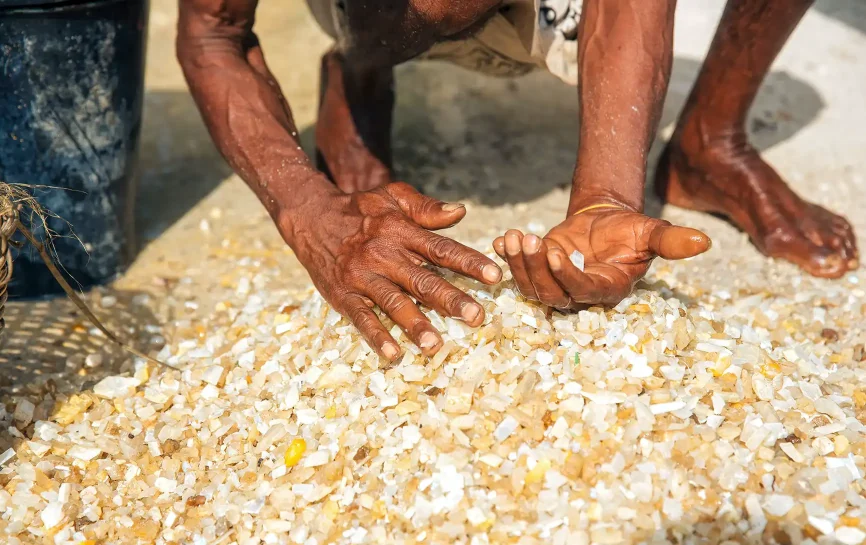
In Tanzania, children have been found to work in underground tanzanite mines and engage in gemstone brokering. Children, typically boys, called “snakes” crawl through narrow tunnels in unregulated tanzanite mines to help position mining equipment and explosives.[23] In the Merelani tanzanite mines, young boys work in tunnels as deep as 100 meters, and miners do not use any form of personal protective equipment.[24] The 2014 Tanzania National Child Labour Survey showed that out of 4.2 million child laborers from the ages of five to 17, 13,493 boys and 17,334 girls worked in mining and quarrying.[25]
Recent discoveries of massive sapphire deposits in eastern Madagascar’s protected rainforests have brought thousands of miners to the area in another gem rush. Madagascar produces nearly half of the world’s sapphires, and much of the mining industry here is unofficial, and therefore unregulated. Most workers in gemstone mines are internal migrants.[26] The environmental consequences of the expanding mining, much of it illegal, could affect thousands of rare species of plants and animals as people divert waterways and clear landscapes in hopes of participating in the sapphire trade.[27] The smuggling of sapphires has been reported, as well as murder and other safety concerns around the mines. Children are used to see if sapphires are present in small holes, and they are particularly susceptible to injuries caused by falling shards and rocks, collapsing pits, and underground fires.[28]
Jewel production and supply chain
The colored stone industry is fragmented and lucrative, with dozens of different types of gemstones mined in 47 countries spread across six continents.[29] Precious stones are extracted most commonly from mines in South America, Southeast Asia, and Africa. Brokers and intermediaries buy rough stones from miners and sell them to exporters who sell the stones again. In some cases, the same gemstones can be sold and re‐sold amongst local traders as many as ten times before progressing further down the supply chain.[30] The exporting process can obscure the source country of the stones. Gemstones are then cut and polished. After polishing, gems are sold on the international market and are ultimately sold by retailers and incorporated into jewelry or other manufactured products. It is estimated that 80 percent of gemstones are extracted via small-scale artisanal mining, and the stones reportedly change hands a number of times between mining and manufacturing, making traceability challenging and opening the door to exploitation of miners by intermediaries.[31]
How do trafficking and/or child labor in jewel production affect me?
Gemstones such as rubies, sapphires, and emeralds are used in fine jewelry, including engagement rings, and the demand has grown in recent years with changing design preferences and discoveries of new sources.[32] These luxury items are mostly exported to industrialized countries, including the United States. Jade is a very durable gemstone that has been popular for use in jewelry, sculptures, and other ornamental objects since the Neolithic period. The current market for jade is driven by high demand in China.[33] Gems and crystals, like quartz, amethyst, jade, and ocean jasper may also be used for healing purposes in the form of jewelry, lamps, or other personal and household items.[34] The crystal industry has grown in recent years, in particular the healing crystal subset of the global wellness industry. Media reporting indicates that crystal mining involves low paid and unsafe work that is sometimes performed by underage workers.[35] Some crystals are also found in gold, copper, or cobalt mines and are thus considered a “profitable mining byproduct.”
With so many small-scale mines scattered throughout remote areas of the world, consumers wishing to buy gemstones or other products made from gemstones produced without human trafficking or child labor may find it difficult to guarantee the traceability of stones. Given this method of mining, monitoring each mine is not feasible.
Examples of what companies, governments and others are doing
The Responsible Jewellery Council (RJC) is a voluntary company initiative with multi-stakeholder consultative components that includes a certification system.[36] In April 2019, the RJC published a new version of its certification standard, the “Code of Practices,” that now includes silver and colored gemstones. The Code of Practices includes requirements that seek to ensure responsible supply chains, due diligence on human rights, labor rights, and working conditions, responsible mining, and adequate standards of health, safety and environmental protection. This includes key requirements for members to “provide for, or support legitimate processes to enable, the remedy of any adverse human rights impacts that they have caused, contributed to or been linked with”, and to “communicate annually with stakeholders about their human rights due diligence efforts and remedy activities.”[37] All RJC members are required to comply with the standard and are audited against it two years after joining.[38]