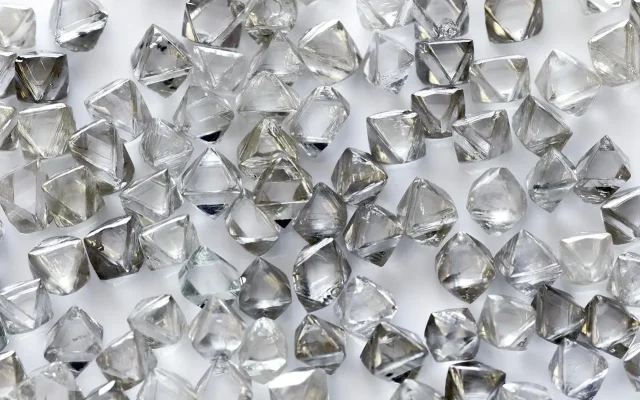
Diamonds, often associated with luxury, are also linked to forced labor, child labor, and conflict in producing regions.
Mining is concentrated in Africa, Asia, and South America, where hazardous conditions, weak oversight, and informal operations drive risks of exploitation. Smuggling, conflict financing, and unsafe artisanal mining further entrench social, human rights, and environmental challenges across the sector.
- Angola (FL, CL)
- Central African Republic (CL)
- Democratic Republic of the Congo (DRC) (FL, CL)
- Guinea (CL)
- Liberia (FL, CL)
- Sierra Leone (FL, CL)
Diamonds (cut and polished):
- India (CL)
- India
- United States
- Hong Kong, China
- Belgium
- Israel
- United Arab Emirates
- Russia
- Botswana
- South Africa
- Canada
Source: International Trade Center (ITC Calculations based on UNCOMTRADE Statistics). https://www.intracen.org/
- India
- United States
- Hong Kong
- Belgium
- China
- United Arab Emirates
- Israel
- United Kingdom
- Switzerland
- Thailand
Source: International Trade Center (ITC Calculations based on UNCOMTRADE Statistics). https://www.intracen.org/
Where are diamonds reportedly produced with trafficking and/or child labor?
According to the U.S. Department of State 2019 Trafficking in Persons Report, diamonds are listed as being produced with forced labor and child labor in Angola and Sierra Leone, and with child labor in the Central African Republic, DRC, Guinea, and Liberia.[1] According to the U.S. Department of Labor’s 2018 List of Goods Produced by Child Labor and Forced Labor, diamonds are produced with forced labor in Liberia and Sierra Leone, with forced child labor in Central African Republic and Guinea, and with forced labor and forced child labor in Angola and DRC.[2] The U.S. Department of Labor’s 2018 List of Goods Produced by Child Labor and Forced Labor also notes that gemstones, possibly including diamonds, are produced with child labor in India.[3]
Angola, Central African Republic, Liberia, and Sierra Leone are listed as Tier 2 Watch List countries by the U.S. Department of State 2019 Trafficking in Persons Report. Guinea and India are listed as Tier 2 countries, and Democratic Republic of Congo is listed as a Tier 3 country.[4]
What does trafficking and/or child labor in diamond production look like?
Bonded labor, physical, and sexual violence, abusive and dangerous working conditions, and the use of middlemen in the supply chain have been reported specifically in the diamond mining industry, while withholding of wages, excessive overtime, and abusive working and living conditions can be found in the diamond cutting and polishing industry. Diamond mining has funded conflicts that have utilized forced labor.
Bonded labor has been reported specifically in Angola and Sierra Leone. According to some reports, trafficking in Angola’s diamond sector can be a result of bonded labor in which “sponsors” pay for a miner’s expenses and are reimbursed through a portion of the mined diamonds.[5] In Sierra Leone, miners, mostly young men, enter into bonded labor whereby they receive tools and housing but no compensation for their work.[6]
In Brazil, despite protests from indigenous communities, armed miners have taken over mines on the traditional lands of the Cinta-Larga tribe.[7] Reporting from Insight Crime indicates that members of the Cinta-Larga indigenous tribe, whose land is thought to contain some of the world’s largest diamond reserves, experience high rates of debt, in part due to coercive practices used by lenders that result in unfair interest rates and lack of transparency. In order to pay off this debt, tribe members allow miners to access their land, with the expectation that they will receive a cut of the sale of any diamonds found in return as payment.[8]
The phenomenon of middlemen, or “collectors,” is common in artisanal mining in a number of countries. The informal nature of the sector leads to a setup in which miners are paid far less than the diamonds’ worth by middlemen, who are often in charge of recruiting miners and may charge fees for the use of equipment. Sometimes miners are unaware of the actual worth of the diamond, or they are in debt to the collector and have no choice but to sell to them. In Central African Republic (CAR), for example, there are 80,000-100,000 artisanal miners, a mere five percent of whom are formally registered as miners with the government. Middlemen, who are sometimes government officials themselves, therefore play a large role in the diamond supply chain, leading miners into cycles of debt that can make them more vulnerable to forced labor.[9]
In Angola, the Central African Republic, Zimbabwe, DRC, Sierra Leone, and Liberia, diamonds have been linked with the funding of violent and protracted civil wars, which lead to a worsening of mining conditions and an increase in forced and child labor. In the Central African Republic, human rights groups have documented that diamonds have funded the two primary parties of the armed conflict and that violence was significantly on the rise, particularly in diamond rich areas.[10] Reuters reported that the uptick in violence was at least partially due to armed groups struggling for control of diamond mines, citing aid workers.[11] In May 2017, 115 bodies were found in a diamond mining town.[12]

Armed groups have employed children in a number of these and other conflicts, most notably as combatants. In the Central African Republic, UNICEF has reported that nearly 10,000 child soldiers have been recruited since 2013,[13] with the UN noting in 2015 that children there were being used by armed groups as informants, cooks, messengers, and for sexual exploitation. In the DRC, there was a marked increase of violations against children, with 2,549 confirmed by the UN in 2015.[14] The conflict in Sierra Leone resulted in over 12,000 children being forced to fight as soldiers.[15]
In June 2009, Human Rights Watch (HRW) reported that Zimbabwe’s army used forced and child labor to mine diamonds in eastern Zimbabwe, specifically in the Marange fields.[16] Citizens that did not cooperate with the operation were allegedly beaten and tortured.[17] A 2018 report by the Human Rights Watch confirmed the persistence of such human rights violations in the Marange diamond fields of Zimbabwe, stating that residents who lived near the diamond fields continue to suffer from forced labor—for example, being made to dig for diamonds at gun point—torture, and other abuses by security forces employed by the diamond mining company.[18] HRW also reported forced child labor is this context in which children were made to carry bags of mined ore without pay.[19] A local Zimbabwean NGO, the Centre for Research and Development (CRD), has documented regular abuses against illegal miners and local residents since mining operations were nationalized in early 2016.[20] Local residents have reported that police have infringed on their freedom of movement, with door-to-door searches for illegal diamond miners creating a climate of intimidation.[21]
Commercial sex work and sexual exploitation, including the possibility of sex trafficking, are present around mining camps, due to the transitory nature of the workforce and the isolation of worksites. Mining camps around pits reportedly have high rates of HIV/AIDS.[22] According to the 2019 U.S. Department of State’s Trafficking in Persons Report, forced labor and sex trafficking have been reported in Angola and Sierra Leone, particularly among Congolese migrant workers, some of whom migrate without documentation into Angola in order to work in the country’s diamond mines. Angolan soldiers routinely demand bribes from these migrant miners, beating and killing them if they refuse to pay; many migrants are expelled every year, and migrant women are often raped in the process. Traffickers in Sierra Leone recruit workers largely from rural provinces for exploitation in sex trafficking and forced labor in diamond mining.[23] In diamond mining areas of the Democratic Republic of the Congo, girls and women are frequently exposed to sexual abuse, including commercial sexual exploitation. Girls in mining areas may be forced to marry. According to a report by Swedwatch, it is common for parents to sell 12-year-old girls as spouses to men who work in diamond mines with them. Forced prostitution of girls as young as 10 around the mining areas is also prevalent.[24] Drugs and prostitution are also reportedly common around diamond mines in Brazil.[25]
An estimated one million children aged 5 to 17 work in small-scale mining (so-called artisanal mining) globally, and the number is said to be increasing.[26] In Sierra Leone and other post-conflict societies, children, particularly orphans or children living without their parents, may work in the diamond mines as a means to support themselves and their families. There are also reports of child labor in diamond mines in Northern India.[27] Mining, though extremely hazardous, offers livelihood opportunities that are lacking in countries with collapsed economies. Due to their small size, children are used for excavation work in small pits.
Child labor is also prevalent in the diamond cutting and polishing industry. In India, which handles the cutting, polishing, and manufacturing of 92 percent of the world’s diamonds,[28] children are reportedly involved in cutting and polishing diamonds.[29] Children are considered more suitable for diamond processing in particular due to their sharp sight and steady hands, allowing them to cut stones more precisely than an adult worker.[30] These children are exposed to repetitive stress injuries, eyesight strain, and toxic dust.[31]
According to a 2018 Routers report, withholding of wages, excessive overtime, and abusive working and living conditions also occur in India’s diamond cutting and polishing industry.[32] Many Indian polishers work in small enclosed spaces with no ventilation, eat and sleep in the workshops in degrading conditions, and lack the social and healthcare benefits of other factory workers. Many diamond workers take out loans that they are not able to repay. Additionally, many diamond workshops are located in remote, isolated areas, making any monitoring difficult.[33] Reuters’ investigation into police files revealed that there is a very high suicide rate among Indian diamond workers. These suicides were most often associated with unpaid loans and low wages, which prevented workers from being able to feed or educate their families.[34]
Artisanal diamond mining is hazardous for all workers and for children in particular. Workers are exposed to heavy minerals and chemicals, mudslides and floods, and collapsing pit walls. A number of fatal mine collapses have been reported in recent years, including incidents in Zimbabwe, Botswana, and South Africa. The physical nature of mining commonly leads to injuries, such as hernias, and general exhaustion.
Mining also leads to degraded and polluted ecosystems in areas surrounding the mines.[35] The World Atlas notes that mining can lead to the loss of biodiversity, erosion, and the contamination of surface water, ground water, and soil, in addition to affecting the health of the surrounding population due to contamination from chemical leakage.[36] In countries such as Angola and Sierra Leone, land that is cleared for open pit mines becomes vulnerable to soil erosion, and in turn, flooding.[37] Around the Marange mines in Zimbabwe, numerous rivers downstream from the mines have been found to contain bacterial, chemical, and heavy-metal pollution. Cattle have died and villagers have gotten sick after drinking the water.[38] A toxic chemical compound called ferro-silicon contains chromium and nickel, both carcinogenic metals, and iron, which can be poisonous in large quantities.[39] Further environmental damage is caused by the large quantities of water, a scarce resource across Africa, used to extract diamonds. In 2012, approximately 324, 451 million liters of water was used in diamond production worldwide.[40] On October 2016, villagers in Mutare, Zimbabwe formed a coalition to push the government to enforce environmental regulations and to ensure the rights of those living around mining areas after discovering that a section of the Save River, which stretches from the middle of Zimbabwe through Mozambique and into the Indian Ocean, had dried up due to diamond mining practices.[41] This drying of the river had widespread impacts on villagers, since they used the river for drinking, irrigation, and fishing. Fishing and irrigation of agricultural land were income-generating activities as fish and produce are traditionally sold to pay school fees for children and to financially sustain families.[42]
Diamond supply chain and production
Diamonds are mined through hard-rock open-pit, or alluvial mining. Alluvial mining, where miners pan for diamonds in water, is most likely to include artisanal and small-scale mining as little specialized equipment is required. Approximately 20 percent of diamonds are mined via artisanal, or small-scale, mining operations.[43] This type of diamond production is most likely to feature forced and/or child labor.
After mining, the digger sells the raw diamonds to a local buyer, either a small diamond shop in the same village or to a middleman who travels between villages and buys diamonds directly from diggers. The diamond is then sold to a diamond trader in a town, either directly at a local diamond market or by the middleman, and is then mixed in with diamonds from other mining sites. In some countries, like the DRC, diamond traders must allow an official from a government agency overseeing gem exports to evaluate each batch before exporting the diamonds. Once diamonds are exported to diamond trading hubs (or exchanges), the largest of which are in Antwerp and Dubai, they are sorted according to shape, color, size and carat. The rough diamonds are then usually sent to India for cutting, polishing, and manufacturing.[44] Diamonds may be traded multiple times before being sent to cutters and polishers.[45]
Over 90 percent of the world’s diamond pieces are cut in Surat, India contributing to about 80 percent of the annual Indian diamond export.[46] Some producing countries such as Zimbabwe and Angola[47] have also begun to cut and polish their own diamonds, although the diamond cutting and polishing industry in Zimbabwe is struggling due to issues such as a lack of access to regional markets and problems in certification of polished diamonds.[48]
From India, diamonds are sold to traders for manufacturing and retail, mainly in China, Antwerp, Israel, New York, London, and Shanghai. Diamonds are then used for jewelry manufacturing. Jewelry can be sold to customers or jewelry stores, and the main markets for diamond jewelry are the US, China, India, Japan, and Europe. [49]
Diamonds are extracted in approximately 30 countries, and their extraction involves an estimated ten million workers.[50] New York and London are major centers of diamond sales. The diamond industry is very centralized, with just a few major corporations like De Beers and ALROSA accounting for the majority of global production and trade. However, according to a 2017 Global Witness report, traffickers have recently begun trading illegal conflict diamonds, banned by the Kimberley Process, from the Central African Republic on social media using Facebook, Messenger, and WhatsApp.[51]
Eight and a half billion rough diamonds, or 65 percent of the global trade, are from African countries, including those that have been cited for forced and/or child labor.[52]
How do trafficking and/or child labor in diamond production affect me?
Diamonds are used in jewelry and industrial tools. Industrial uses of diamonds, such as cutting and drilling, account for 70 percent of all diamonds, generally those of lesser quality.[53] With the slogan “A diamond is forever,” De Beers marketed diamond rings as the symbol of love and fidelity. Approximately 75 percent of American brides wear a diamond ring.[54]
Examples of what governments, corporations, and others are doing
The main global standards that have been developed specifically for precious metals and stones include the Due Diligence Guidance for Responsible Supply Chains for Minerals from Conflict-Affected and High Risk Areas by the Organization for Economic Co-operation and Development (OECD), the Kimberly Process Certification Scheme, and two standards by the Responsible Jewellry Council. [55]
OECD Due Diligence Guidance: A poorly implemented key standard
The OECD’s “Due Diligence Guidance for Responsible Supply Chains for Minerals from Conflict-Affected and High Risk areas” elaborates on the concept of human rights due diligence from the UN Guiding Principles on Business and Human Rights and applies to the sourcing of all minerals, including diamonds. It requires all companies in a supply chain, along with jewelers and watch companies, to conduct due diligence on their suppliers when sourcing from conflict-affected and high-risk areas. According to a 2018 Human Rights Watch Report, two weaknesses of the Due Diligence Guidance include its voluntary nature and a lack of monitoring and implementation. Many states have failed to establish mechanisms to track implementation by companies in their country, and companies often do not put the Due Diligence Guidance into practice. [56]
The Kimberly Process: Protection against abuses in diamond production?
The Kimberly Process Certification Scheme (KP) emerged in response to the increased use of conflict or “blood” diamonds to fund violent civil wars in Africa. It is a government-led international certification scheme, established in 2003, to stem the flow of conflict diamonds,[57] defined as “rough diamonds used to finance wars against governments.” [58] The Kimberly Process Certification Scheme is intended to guarantee that diamonds are “conflict free.” However, this process does not cover all human rights abuses and is limited only to “rough diamonds used by rebel movements or their allies to finance conflict aimed at undermining legitimate governments.” The initiative requires documentation of the country of origin of each shipment of rough diamonds, but not of the mines of origin.[59]
According to a 2018 Human Rights Watch report, weaknesses of the KP include its narrow focus on curbing the trade of diamonds whose sale benefits armed groups rather than on abusive governments or their armed forces.[60] For example, the Kimberly Process has authorized exports of Angolan and Zimbabwean diamonds despite their having been mined under highly abusive conditions.[61] Furthermore, since the Kimberly Process only applies to batches of rough diamonds, stones that are fully or partially cut fall outside of its scope. [62] Diamond shipments that pass through trading hubs are frequently mixed with diamonds from other exporting countries, making it impossible to trace the diamonds to their initial country or mine of origin. The KP has also failed to impose sanctions on countries who have been noncompliant with the minimum requirements, and to enforce due process in diamond suppliers, since the World Diamond Council’s System of Warranties, meant to reinforce the KP, requires only oral assurances by diamond suppliers rather than monitoring them independently. [63]
A 2015 Amnesty International report on the diamond industry in the Central African Republic (CAR) criticized the KP for failing to force companies sourcing from the CAR to exercise their due diligence. The report sees this failure as a result of the process’s inability to address other human rights abuses not related to conflict wars, as well as countries’ internal markets for diamonds.[64] Global Witness has noted that, although diamonds from CAR were banned in 2013, diamonds funding armed groups still reached global supply chains.[65] According to a 2014 U.N. report, an estimated 140,000 carats of diamonds, with a retail value of USD 24 million, have been smuggled out of the CAR since it was suspended in May 2014.[66] A U.N. expert panel reported that, in addition to funding the conflict in CAR, these diamonds were also funding armed groups in Cameroon and Chad.[67]
The Responsible Jewellry Council: Company initiative to enforce responsible sourcing
Founded in 2004 by a small group of 14 companies and trade associations with the goal of increasing consumer confidence that their jewelry purchases are responsibly produced, the Responsible Jewellery Council (RJC) is composed of over 1,000 companies in the jewelry industry, including jewelers, manufacturers, refiners, mining companies, and others. Members of RJC commit to and are audited against the Code of Practices, a standard establishing responsible business practices in the jewelry supply chain. An additional optional standard is the Chain-of-Custody standard. Shortcomings of the JRC include flaws in its governance, standards, and system of audits that allow for companies who fail to meet basic human rights standards to become JRC certified. Furthermore, its decision-making board is made up of only industry representatives from different positions in the supply chain, but does not include consumer groups, representatives of mining communities, trade unions or miners’ associations, or human rights nongovernmental organizations.[68] In 2016, the RJC renewed their partnership with the Alliance for Responsible Mining (ARM) with a stated focus to align standards and improve practices in these areas.[69]
An additional initiative focused on the diamond mining industry is the Diamond Development Initiative (DDI), which works within the Kimberley Process and alongside the KP Certification Scheme to address development issues that affect artisanal and small-scale mining, where the problem of conflict diamonds often originate.[70] The DDI works to help formalize and promote responsible artisanal diamond mining. It also offers certification against the Mendeleo Diamond Standard, which addresses issues beyond the conflict-focus of other diamond initiatives including labor conditions, child labor, health and safety, and environmental protection. [71]
Tiffany & Company has recently taken significant steps towards diamond traceability making it a top-ranking jewelry company on the responsible sourcing of diamonds. Tiffany and Co. assisted in launching the Initiative for Responsible Mining Assurance in 2006, an independent standard for responsible mining which offers certification to individual mine sites rather than mining companies. Tiffany and Co. has a public Supplier Code of Conduct, conducts regular audits for “high risk” suppliers for a sample of medium and low-risk suppliers, and requires their supplier to carry out self-assessments of human rights risks. It also has a partial chain of custody over its diamonds, allowing it to trace some of its diamonds to specific mines. [72] In January of 2019, it started a program that identifies for customers the country where their diamond was mined, and, in 2020, it will share information about where each diamond was cut, polished, and set.[73]
In an effort to eliminate irregular diamond mining operations in Angola, border security forces successfully shut down illegal diamond mining cooperatives by expelling and detaining over 400,000 migrants (primarily Congolese), many of whom were refugees.[74] The strategy of expelling Congolese miners began in 2003 and created a refugee crisis in DRC. Despite these efforts, human rights observers reported multiple cases of abuse along the Angola-DRC border.
Botswana has often been described as a success story of how diamond mining can directly benefit an entire country. This has been due in part to a low level of corruption, effective management of concessions and mines, and fiscal responsibility.[75] Debswana Diamond Co. is a public-private partnership between De Beers and government of Botswana that has made significant CSR efforts in addition to becoming an extremely profitable company. They have sought to address the high rate of HIV/AIDS around diamond mines and to invest in socio-economic programming in mining communities.[76]