
Coltan, tungsten, and tin are sourced from regions where forced and child labor have been documented.
In the Democratic Republic of the Congo, all three minerals are tied to both forced and child labor. Tin production in Bolivia and Indonesia has also been linked to child labor. Complex artisanal mining systems and weak oversight allow these exploitative labor practices to persist.
Coltan:
- Democratic Republic of the Congo (DRC) (FL, CL)
Tungsten:
- Democratic Republic of the Congo (DRC) (FL, CL)
Tin:
- Bolivia (CL)
- Democratic Republic of the Congo (DRC) (FL, CL)
- Indonesia (CL)
Niobium, tantalum, vanadium or zirconium ores and concentrates:
- South Africa
- Malaysia
- Senegal
- United States of America
- Australia
- Indonesia
- Rwanda
- Mozambique
- Congo
- Kenya
Tungsten ores and concentrates:
- Portugal
- Bolivia
- Spain
- Democratic People’s Republic of Korea
- Russia
- Rwanda
- Mongolia
- United States of America
- Hong Kong, China
- Brazil
Tin ores and concentrates:
- Australia
- Congo
- Democratic Republic of the Congo
- Rwanda
- Brazil
- Russia
- Lao People’s Democratic Republic
- Myanmar
- Burundi
- Portugal
Source: International Trade Center (ITC Calculations based on UNCOMTRADE Statistics). https://www.intracen.org/
Niobium, tantalum, vanadium or zirconium ores and concentrates:
- China
- Spain
- Thailand
- India
- United States of America
- Malaysia
- Japan
- Italy
- Belgium
- France
Tungsten ores and concentrates:
- United States
- China
- Republic of Korea
- Russia
- Hong Kong, China
- Vietnam
- Japan
- United Kingdom
- India
- Kenya
Tin ores and concentrates:
- China
- Malaysia
- Thailand
- Taipei, Taiwan
- United Arab Emirates
- Brazil
- Belgium
- Singapore
- India
- Vietnam
Source: International Trade Center (ITC Calculations based on UNCOMTRADE Statistics). https://www.intracen.org/
Where are coltan, tungsten, and tin
reportedly produced with trafficking
and/or child labor?
According to the U.S. Department of State 2019 Trafficking in Persons Report, coltan (also called Tantalum Ore), tungsten, and tin, three widely-used minerals, are all produced with forced labor and child labor in the Democratic Republic of the Congo (DRC).[1]
The 2018 U.S. Department of Labor’s List of Goods Produced by Child Labor or Forced Labor also reports child labor and forced labor in coltan, tungsten, and tin production in the DRC, as well as child labor in tin mining in Bolivia and Indonesia.[2]
The U.S. Department of State 2019 Trafficking in Persons Report lists Indonesia as a Tier 2 country, Bolivia as a Tier 2 Watch List country, and the DRC as a Tier 3 country.[3]
What does trafficking and/or child labor
in coltan, tungsten, and tin production
look like?
Until recently, armed groups in the Kivu provinces of the Democratic Republic of Congo controlled the majority of the mines. In 2010, the U.N. Group of Experts stated that, “in the Kivu provinces, almost every mining deposit [was] controlled by a military group.”[4] As of October 2016, over three quarters of miners surveyed in Eastern Province were in mines not directly controlled by armed groups,[5] but armed interference in the form of required bribes continued to be widespread.[6] The U.S. Department of State notes that armed groups in the DRC continue “to illegally tax, exploit, and trade natural resources for revenue and power,”[7] and Human Rights Watch’s 2019 Word Report notes that armed groups continue to enact violence, resulting in an overall unstable condition for the country.[8] In some cases, groups in power surrounding mining sites reportedly forced local miners to work at gunpoint without pay at their mining site for short periods of time – a process known as “solango.”[9] Workers in artisanal mines reportedly took loans from intermediaries in order to purchase tools and equipment necessary for mining as well as food resulting in debt with high interest rates. There is evidence that if workers could not produce enough ore to repay their debts they are “at risk of becoming perennial debtors” and experiencing debt bondage.[10]
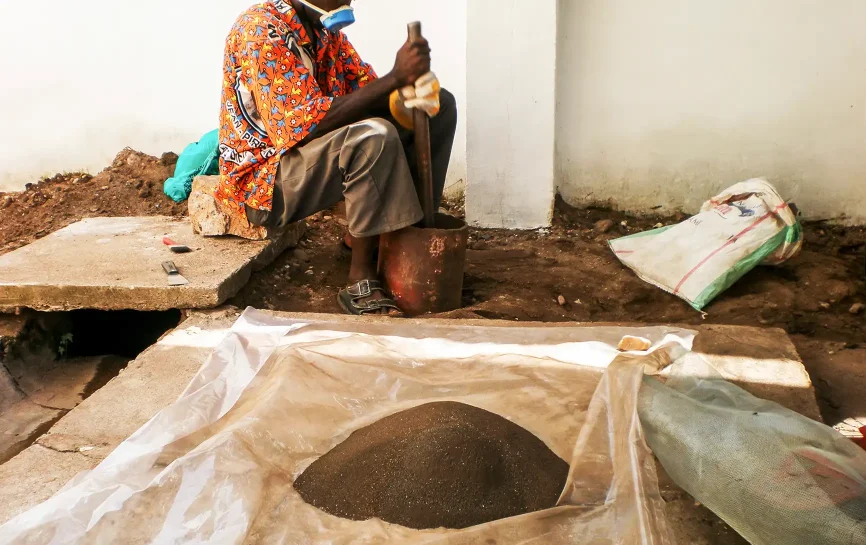
In the DRC, child labor has been reported in the mining of coltan, a mineral used to produce cell phones, laptops, and electronic gaming. Coltan is toxic and can cause birth defects. These child workers are often in forced labor, made to work long hours digging for conflict minerals. Children and adult laborers work in narrowly dug tunnels in river beds. Children are used for this process as their small size allows them to more easily navigate these passages. However, these tunnels are structurally unsound and prone to collapse, already causing thousands of deaths.[11] Children may work in mines in order to supplement family income so that their siblings can attend school.[12]
Tin may be mined with child labor in Bolivia. Children generally mine tin in Bolivia in artisanal mines or mines abandoned by commercial mining companies.[13] Children, known as “jucus,” are engaged in pushing carts, drilling, and extracting and cleaning ore. Children and adults working in clandestine mines work without adequate safety equipment, ventilation or proper lighting. They are vulnerable to illness, lung damage from dust, repetitive motion stress injuries, injuries from falls, carrying heavy loads, and working long hours.[14] Many mining sites are hundreds of years old and poorly maintained, so workers are also at risk of death in collapsing mine shafts.[15] In 2008, at least 60 children died from mine collapse. An estimated 3,000 children, some as young as six, work in mining in Bolivia.[16] Child workers may pool the ore they mine and sell it to a middleman who then sells it to a smelter; this changing of hands can make supply chains even harder to trace.[17] Tin is also mined on and off shore in Bangka, Indonesia, where media reports indicate that conditions can be both dangerous and deadly for adult and child workers alike.[18]
Coltan (tantalum), tungsten and tin
production and supply chain
The mining, processing, and selling of coltan/Tantalum, Tungsten, and Tin involves numerous steps and intermediaries as the materials move from a raw good mined from the earth to a refined and processed commodity. The tantalum supply chain begins by accessing the mineral’s raw ore through mining, both artisanal and large scale, or by recovering tantalum from tin smelters or recycled scrap metal. Before tantalum is manufactured into consumer goods and products, it goes through mines, smelters, refineries, and manufacturers. Mining is responsible for approximately 74 percent of all tantalum ore, followed by scrap recycling at 18 percent, and tin smelters at 8 percent. Once the raw ore is sourced, it is concentrated by gravity and processed first by smelters, then refineries. At the refinery stage, tantalum is made into products that will later be used for manufacturing, including tantalum metals, powders, and oxides. Any variation in supply, methodology, or access to processing tantalum within this supply chain can disrupt the stability of the mineral’s pricing. These price fluctuations influence many industries in which tantalum is used and can impact the final manufactured consumer good in which it is featured.[19] Following these steps of the supply chain, tantalum is used to make electrical equipment, turbine blades, and surgical instruments, among other things.[20] Tungsten is typically mined underground, where the ore is found in narrow veins; tungsten mines tend to be small. After the tungsten ore is mined, it is crushed and milled to release the tungsten mineral crystals, which are then concentrated.[21]
Despite government efforts to prevent it, smuggling of conflict minerals is prevalent within the Democratic Republic of Congo.[22] Al Jazeera reported that while the introduction of conflict-free supply chains has increased the revenue of artisanal and small scales mines, from which conflict minerals were typically smuggled, the continued smuggling of these minerals “calls into question the traceability mechanisms” within the larger supply chain. Anti-smuggling efforts have included tagging bags of minerals with barcodes, which are then logged and tracked by companies operating in DRC and Rwanda.[23]
Intermediaries are involved in tantalum, tungsten, and tin supply chains in numerous countries. In Indonesia, for example, middlemen buy tin that informal miners collect through diving or digging, and then mix it together with tin bought from official mines; they then sell the mixed tin to smelters.[24] In the DRC, after minerals are mined, they are bought by individual traders known as “negociants” who maintain relationships with the parties controlling the mines. The negociants sell the minerals to trading houses, where they are sorted. The minerals then are purchased by exporters called “comptoirs.” Some comptoirs may also buy minerals directly from the mines. These comptoirs are licensed and registered with the Congolese government. European and Asian companies use the comptoir’s “legal” status as a justification to buy from the DRC. The comptoir is not required to provide any documentation, so information on the minerals’ origin can be easily obscured at this step. Finally, to be used or sold on the global market, the minerals must be refined. This is most commonly performed by companies in East Asia, who may combine Congolese minerals with minerals from other countries.[25]
According to the Enough Project, “when it comes to tracing supply chains back to their sources, refiners are the critical link. After the mineral ore is refined into metal, it becomes impossible to distinguish tin or tantalum that originated in Congo from other sources, and supplies from all over the globe are mixed together at this step in the chain.”[26] The refiners then sell the minerals to manufacturing companies. Challenges in the supply chain include the dispersed and informal nature of mining and the illegal transfer of minerals from the DRC to Uganda, Rwanda, and other neighboring countries.[27]
How do trafficking and/or child labor in coltan, tungsten, and tin production affect me?
Coltan, tungsten, and tin are commonly used in electronics such as cell phones and computers. Conflict minerals can be found in products ranging from jewelry to electronics and appliances.[28]
Coltan: Coltan is the source of the minerals niobium and tantalum. In the context of the DRC, coltan generally refers to tantalum, which is used widely in the capacitors of common electronics like cell phones and laptops. Tantalum is also commonly used in the automotive industry and for jet engines.[29]
Tungsten: Derived from wolframite, tungsten is used in electronics due to its high conductivity. It is also used as an alloy to strengthen steel and can be found in golf clubs.[30]
Tin: Often found alongside coltan, tin from cassiterite has a wide variety of uses from the production of tin cans to tin solder and circuit boards in electronics.[31]
Together, these minerals are sometimes referred to as the “3 T’s,” an abbreviation of tantalum, tungsten and tin.
Examples of what governments, corporations, and others are doing
In July 2010, the U.S. Congress passed Section 1502 of the Dodd-Frank Wall Street Reform and Consumer Protection Act, which “requires companies using cassiterite, coltan, wolframite, and gold to find out whether the metals originated in the DRC or neighboring countries.” If the metals do originate from this area, then the companies must thoroughly review their supply chain to see if the mining of the metals “benefited abusive armed groups in eastern DRC.”[32] This provision in the Dodd-Frank act was criticized by some for its potential to cause a defacto boycott on all minerals from the DRC, with some companies noting the difficulty of verifying the source due to the extremely weak and chaotic regulatory environment. However, multiple companies have now committed to sourcing ethical minerals from within the DRC by working with NGOs to create traceability and tracking systems.[33] In 2017, it was reported that President Trump was considering an Executive Order to suspend the conflict minerals provision of the Dodd-Frank Act; proponents of the Act and Section 1502, including academics, NGO professionals, industry, technology, and mining sector representatives, and religious organizations have voiced their concern for such a repeal.[34]
Beginning in 2012, domestic laws in Rwanda and the Democratic Republic of Congo required that companies working in minerals disclose their operations and complete due diligence requirements in assessing their supply chains. As of February 2012, the DRC government requires “all mining and mineral trading companies operating in the country [to carry] out supply chain due diligence, in line with international standards set by the Organization for Economic Cooperation and Development (OECD), to ensure their purchases are not supporting warring parties in eastern DRC.” The DRC enforced the law last May, suspending two mineral traders who violated the Congolese law.[35] However, few of the companies operating in the Great Lakes mineral sector release their due diligence reports on an annual basis. A European Commission Impact Assessment in 2014 found that 93 percent of surveyed companies working in minerals in this region do include a conflict minerals policy or a due diligence procedure in their annual reports or websites.[36] According to the U.S. Department of State, in 2018 the “government continued efforts to certify mines to prevent the use of forced and child labor,”[37] and, due to regulatory efforts enacted by the government, there is a “small but increasing amount of legal conflict-free [cassiterite, coltan, and wolframite] export” from certain regions.[38]
In 2014, Global Witness reported that the Chinese Chamber of Commerce for Minerals, Metals and Chemicals Importers and Exporters (CCCMC), a branch of the Chinese Government, published guidelines for the mining and trading of conflict minerals. These standards were published to prevent conflict and corruption within mineral mining in addition to protecting both labor and environmental labor rights. The CCCMC offers trainings and outreach to companies wishing to be more sustainable in their mineral consumption.[39]
The Electronics Industry Citizenship Coalition and the Global e-Sustainability Initiative introduced the Conflict Free Smelter Program, which requires third party auditing. As of 2019, approximately 380 companies and associations reportedly participate in the initiative.[40]