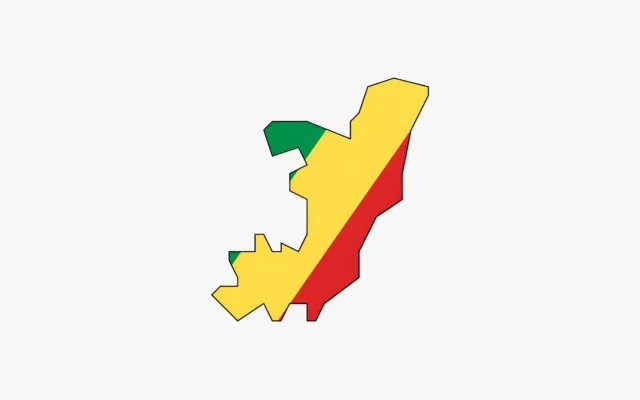
Overdependence on oil revenue and deep inequality sharpen trafficking risks across artisanal and rural sectors in the Republic of the Congo.
Oil dominates the economy, with exports including petroleum, copper, wood, tin, and transition metals—but profits largely benefit the political elite, fueling underinvestment in public services and fragile infrastructure. Urban electricity access is limited (40%), and rural access more so (10%), while most people work in the informal sector. Trafficking risks emerge in agriculture and fishing—especially involving children and migrants—as well as in domestic service and sex work targeting migrant women and girls. Labor protections exist in law but remain weakly enforced, especially in informal industries.
Republic of the Congo (ROC) country overview
Politics
The Republic of the Congo (ROC) is a presidential republic in West Africa. Current president, Denis Sassou-Nguesso, has been in power since 1997 when a civil war ousted the first democratically elected government.1 Sassou-Nguesso was re-elected in March 2016 after a constitutional referendum changed the presidential term limit from two terms of seven years to three terms of five years.
Many observers, including domestic NGOs, foreign governments, and international organizations, question the validity of both the constitutional referendum process and the 2016 presidential election, which was met with civil unrest. 2 A revival of the Ninja rebel group of the southeastern Pool region sparked violence against the government, which ended in a 2017 ceasefire.3 According to Amnesty International, opposition leaders were arrested – and some were killed – following the presidential elections and violence broke out following the Constitutional Court’s endorsement of the election results.4 The final peace accord from the 1997-1999 civil war was signed in 2003, but political unrest continues.5
Economy
The Republic of the Congo is classified by the World Bank as a lower middle-income economy.[6] The country’s revenue relies heavily on oil production, which decreased by 10.7 percent from 2020 to 2021. [7] Annual GDP growth has declined in recent years, with 2021 GDP growth being – 2.2 percent. [8] A new oil field was expected to increase GDP growth by 3.6 percent from 2017 to 2019.[9]
Because of the prioritization of the oil industry, the government has directed resources that otherwise would benefit the population. Corruption has long been a problem in the sector, with the majority of profits going directly to the Republic of the Congo’s political elite, with little resources being invested in services and infrastructure to support the rest of the population.[10] Most of the country’s electricity goes toward oil drilling. Only 40 percent of the country’s urban residences have electricity, and only 10 percent of rural homes have access to electricity. [11]
The country’s non-oil sectors include logging, telecommunications, banking, construction, and agriculture.[12] The Republic of the Congo’s major exports in 2022 were petroleum, copper, wood and plywood, tin, transition metals, and zinc. [13]
Environmental threats to the economy include seasonal flooding and deforestation.[14]
The majority of the country’s population is employed in the informal economy.[15] Unemployment rates are high, particularly among young people, which is partly an effect of the low number of jobs available in the oil and gas sector.[16]
Social/human development
There are four main ethnic groups in the Republic of the Congo: Kongo (40.5 percent), Teke (16.9 percent), Mbochi (13.1 percent), and Mbere/Mbeti/Kele (4.4 percent). [17] The population growth rate was 2.3 percent in 2021, and almost 60 percent of the population was under 25 years of age at that time. [18] Seventy percent of the population lives in the two largest urban areas, Brazzaville and Pointe Noir. [19] ROC has one of the lowest population densities in Africa, at 17 people per square kilometer. [20]
Although poverty levels across the population have been declining, they are still relatively high at 40.9 percent in 2011, compared to 50.7 percent in 2004.[21] 2011 is the latest yearly rate reported by the World Bank. The percentage of the population living at USD 2.15 a day (2017 international threshold for determining extreme poverty) has increased from 52.0 percent in 2021 to 52.5 percent in 2022. [22] The Republic of the Congo’s Human Development Index (HDI) score for 2021 was 0.571, ranking the country 153 out of 191 countries and placing it in the “medium” development category. [23] The Human Development Index scores is based on birth expectancy, gross national income per capita, and average and expected years of schooling. Higher scores mean higher human development. [24]
Public education is tuition-free until age 16; however, families have to pay for books, uniforms, and health insurance, which many cannot afford. Educational facilities were reported to be poorly maintained and overcrowded, especially in rural areas. Those without birth certificates, most of whom are Indigenous children, were not allowed to attend school.[25] Access to education was reportedly improving for women.[26]
U.S. Department of State TIP report summary (2023)
U.S. Department of State TIP ranking: Tier 2 watch list
According to the Trafficking in Persons Report, trafficking risk among children and migrant workers may be found in export supply chains in fishing and agriculture. Women and girls, particularly migrant women, are vulnerable to sex trafficking. Hotel owners for example, may exploit women in sex trafficking, often targeting migrant women from the Democratic Republic 3 of Congo. Additionally, forced labor has been identified in agriculture, domestic service, and market vending.
Migrant and other vulnerable populations
The Republic of the Congo had a negative net migration of -1,000 in 2022.[27] Immigrants made up approximately 6.8 percent of the Republic of the Congo’s population in 2020. [28] As of 2020, the largest source country of immigrants was the Democratic Republic of the Congo, followed by Angola, Mali, the Central African Republic, and Rwanda.[29] Approximately 199,410 persons of concern were in the Republic of the Congo at the end of 2022; of whom an estimated 41,039 were refugees, 134,430 were internally displaced persons, and 13,712 were asylumseekers. [30]
The most common destination country for emigrants from the Republic of the Congo was France, followed by South Africa, Tanzania, Gabon, and Mali. [31]
Exports and trade
The Republic of the Congo’s top export in 2022 was crude petroleum, followed by copper, wood, tin, and other transition metals. [32]
The top importer of all goods from the Republic of the Congo in 2022 was China, followed by Italy, Brazil, Thailand, and Greece. [33]
Trafficking in persons risk factors analysis
Legal/policy risk factors
Level of legal protection for civil liberties and workers’ rights
Freedom of association
The Congolese constitution and law allow freedom of association. Citizens also hold the right to collectively bargain. Political, social, or economic groups or associations were required to register with the Ministry of Interior and Decentralization.[34] There have been reported instances of police abductions of unionists, arrests of unionists for peaceful strikes, and unionists being subjected to harassment and threats from government and authority figures.[35]
Working conditions
The law sets the minimum wage at CFA 90,000 (USD 160) per month in the formal sector.[36] There is no official minimum wage in the agricultural sector and other informal sectors. The high cost of urban living causes many working in the formal sector to seek secondary employment in informal sectors. There is no legal limit on the number of hours worked per week, but the law does provide a standard work week of seven hours per day with a one-hour lunch break for five days per week. The law also calls for at least 24 hours without work each 7 week. The law requires overtime pay for work outside of regular working hours. There are no laws prohibiting excessive compulsory overtime.[37]
The U.S. Department of State has reported that observance of workplace safety standards and law is often lax, and that workers do not have any specific right to leave work situations that could harm their health or safety without jeopardizing their employment. There are no reported exceptions for foreign or migrant workers in ROC. It is also reported that authorities do not protect workers effectively in unsafe working situations. There have been reports of violations of wage, and overtime laws in fishing, logging, stone quarries, and construction sites.[38]
Discrimination
The constitution prohibits discrimination based on family background, ethnicity, social condition, age, political opinion, gender, religion, region of origin, residence, HIV-positive status, or disability. The U.S. Department of State has reported that these provisions are not reiterated in law outside of the constitution. Discrimination often occurs towards women, refugees, and Indigenous people. There are currently no prohibitions on discrimination against LGBTQI+ people. The law also stipulates that women should receive equal pay for equal work, but most women are employed in the informal sector where labor law is not often followed.[39]
The Indigenous population of Republic of the Congo, which constitute 10 percent of the population, face marginalization in employment, health services, housing, and education.[40] In 2015, suppressive electoral practices discouraged Indigenous peoples from voting.[41]
Forced labor
The constitution prohibits forced labor unless it is part of a criminal penalty mandated in court, such as forced prison labor. The government has not regularly enforced the prohibition of forced labor, a persistent issue throughout the country. Forced labor has been identified in agriculture, domestic service, and market vending. In the southern regions, Indigenous workers working in agriculture may receive limited to no pay and may receive threats of abuse. [42]
Child labor
As of 2021, the Republic of the Congo made moderate progress on confronting child labor, conducting its first survey on child labor with the UN Children’s Fund.[43] The minimum legal working age is 16. The law also prohibits forced child labor, child trafficking and all forms of slavery, child soldiering and forced recruitment for child soldiering, and prostitution for all persons under 18. The law provides the maximum penalty for violators of the worst forms of child labor is a fine of CFA francs 1.16 million (USD 1,937 as of 2023) or five years in prison. The U.S. Department of State has reported minimal enforcement of these laws and very little prosecution of violators.[44]
Civil society organizations
Some domestic and international human rights groups occasionally operated without government restriction. Human rights groups had limited access to prisons and detention 8 centers. Domestic human rights groups did not often report on specific incidents out of fear of government reprisal.[45]
Immigration policies limiting the employment options or movement of migrants
There are no reported discriminatory immigration laws in the Republic of the Congo. However, there are no legal services provided to immigrants entering ROC in regard to accessing the labor market or specific economic sectors. Various state decrees prohibit refugees and migrants from working in certain trades such as the public-transportation sector.[46] The Congolese government does not provide guidance to immigrants on how to safely enter work in the country. This means that immigrants and refugees do not have legal support in entering formal or safe work, therefore compelling them to work in the informal sector. The U.S. Department of State has noted that low-level corruption in immigration and customs does occur as of 2016. [47] West African immigrants were also targeted for deportation from Republic of the Congo, and immigrants primarily from the Democratic Republic of Congo were subject to frequent and arbitrary arrests.[48] [49]
Ratification of ILO conventions related to human trafficking or rights of workers and migrants
[35]
Use of export processing zones (EPZs)
The Republic of the Congo is in the planning stages for four special economic zones (SEZs).[51] The goal of these SEZs is to diversify the economy and break the economic dependence from oil. Aspiring to improve foreign investment, the SEZs will include a mineral port, an industrial park, and tourist attractions.[52] The SEZs are expected to be located in the oil hub of PointeNoire, capital city Brazzaville, as well as Ouesso and Oyo in the north. As of 2022, the SEZs have yet to become operational. [53]
Political risk factors
Political instability or conflict
The Republic of the Congo scored a 90.7 in the 2023 Fragile State Index putting it in the “alert” category.[54] The Republic of the Congo’s score worsened by an average of one point per year every year between 2014 and 2017 and has continued to decline. [55] According to Amnesty International, opposition leaders were arrested and faced violence following the most recent election.[56] The U.S. Department of State considers the Republic of the Congo to be a “postconflict society.” The final peace accord from the 1997-1999 civil war was signed in 2003, but political unrest continues, including a civil conflict in 2016-17. [57]
Level of crime and violence
The U.S. Department of State reports that the crime threat level in the capital of Brazzaville is high, while there is a medium-threat level for political violence and a low-level threat for terrorism in the country.[58]
State persecution
Amnesty International reported that political opponents to President Sassou-N’guesso face arrest and intimidation. Security forces have also been reported to torture those who are dissenters.[59]
The U.S. State Department reported that sex workers and gay men are targeted for arrest and face harassment. [60]
Refugees and immigrants are frequently targeted in the Republic of the Congo. There have been numerous reports of immigrants being targeted for arrest by security forces. “Irregular immigration” was often the justification for the arrest, despite the refugee carrying valid identification cards indicating their status. Refugees from the Central African Republic (CAR) are targeted under the claim that because the war in the CAR has ended, they are no longer refugees. Various state decrees prohibit refugees and migrants from working in certain trades such as the public-transportation sector. [61]
Indigenous peoples also face persecution and discrimination. The U.S. Department of State reported that Indigenous citizens in the Congo faced marginalization in employment, health services, housing, and education. Suppressive electoral practices were reported during the 2015 referendum to prevent Indigenous peoples from voting.[62]
Level of corruption
The Transparency International Corruption Perception Index scores Republic of the Congo as 21 out of 100, where 0 signals “highly corrupt” and 100 signals “very clean.” Congo ranked 164 out of 180 on that index.[63]
The World Bank’s Worldwide Governance Indicators reported government corruption as a severe problem, as the Republic of the Congo was in the sixth percentile for control of corruption in 2021. [64] The U.S. Department of State reported that there is a widespread 10 perception of corruption. One avenue of corruption is the misuse and diversions of revenue from natural resources towards private, overseas accounts. [65] Freedom House reported that the state oil company is under the direct control of President Sassou-N’guesso‘s party which contributes to actual and perceived government corruption.[66]
Socio-economic risk factors
Level of national economic development
The Republic of the Congo is scored in the medium human development category, according the UN Human Development Index (HDI), with a rank of 153 out of 190 (with 190 being the “least developed”). The country’s score of .571 is lower than its northern neighbor Gabon, but higher than its southern and northeastern neighbors, the Democratic Republic of the Congo and CAR.[67]
Level and extent of poverty
The Republic of the Congo has a relatively high level of poverty with 24.3 percent of the population reported as living in “multidimensional poverty” by the United Nations in 2022. [68] When adjusted for inequality, the Republic of the Congo’s HDI score falls from 0.571 to 0.432, a loss of 24.3 percent. [69] The Republic of the Congo’s gross national income (GNI) per capita was USD 2,889 in 2021. This is a significant decrease from 2015, when the GNI per capita was USD 5,080. [70]
Degree of gender inequality
The UNDP scores the Republic of the Congo relatively low on the Gender Inequality Index at .564 in 2021, with the “most equal” score being .013 and the “least equal” score being .820. [71]
Gender equality is protected by the Congolese constitution. The law also stipulates that women should receive equal pay for equal work. Despite this, women were underrepresented in the formal sector and have little access to formal employment benefits.[72] No laws limit women’s participation in the political process but sexual harassment is reported to discourage women’s participation in political activities. The U.N. reports that rape is illegal, but the law is not well enforced.[73] The OECD Social Institutions and Gender Index reports that there are no specific legislation prohibiting domestic violence.[74] Women are also reported to experience economic discrimination with respect to employment, credit, equal pay, and owning a business.[75]
Women have access to land ownership through matrilineal or patrilineal filiations, marriage, and rent or purchase agreements. The World Bank reported in 2012 that only 7.7 percent of women owned land.[76] There have been no reliable reports on land ownership by gender since. While they have the same legal rights to own land as men, women still face discrimination in land rights and assets. In practice, in 2023 it was reported that women lose rights to land in divorce cases. [77]
Landlessness and dispossession
In April 2016, violence reportedly started by the Ninja rebel group drove 17,000 civilians of Brazzaville to leave their homes in southern regions. [78] During the same month, thousands 11 were displaced in the Pool region of the country due to government-led airstrikes.[79] The United Nations reported that 40,329 of the 264,000 displaced people from the Pool region have returned to their homes.[80] 26,875 people remain internally displaced in the Republic of the Congo as of 2023, per the UNHCR. [81]
According to the U.S. Department of State, Indigenous people are often forced to live in substandard housing on the perimeters of villages or are isolated from communities altogether. [82] Logging activity has displaced forest dwelling Indigenous communities. The Congolese government implemented a law to respect the land rights of Indigenous peoples, but reportedly did not enforce this law.[83]
Environmental factors
Deforestation related to oil production is a prominent issue in the Congo Basin. Thirty percent of all African oil fields exists in rainforests, and 90 percent of those rainforests at-risk of oildriven deforestation are in located in the Congo Basin.[84] More than 35 million people live in rainforests prospected for oil and gas fields and face increased vulnerability to oil-driven land dispossession.[85]
For the Republic of the Congo in particular, the country’s Indigenous population is at risk from such deforestation, particularly in the province of Sangha. Since 2000, around 50,000 hectares, or 60 percent of the total tree cover of the province, has been deforested.[86] This has exposed the country’s indigenous Bagombé, Benzélé, and Baka communities as they depend on the rainforests for their food and livelihoods.[87] Communities uprooted by deforestation are vulnerable to trafficking and other exploitative conditions.
Documented trafficking and trafficking risk in key commodity supply chains
Fishing
Fishing overview
Fish accounts for very little of the Republic of the Congo’s exports, with the country having exported 3.842 million USD worth of fish products in 2022.[88] Most commercial fishing occurs off the coast of the city Pointe-Noire, and catches often include tuna, bass, sole, and sardines. Fishing largely remains a subsistence activity.[89]
Documented trafficking in persons risk factors in fishing
The U.S. Department of State reports that exploitation of foreign workers frequently occurs in the commercial fishing sector. Fraudulent employment agents often recruit workers from Benin, Central African Republic, the Democratic Republic of Congo, and Gabon and place them in forced labor.[90] Internal trafficking is common in the fishing industry. Safety and labor violations also frequently occur in the fishing sector, such as wage retention and working extensively long hours.[91]
Oil and gas
Oil and gas overview
In 2021, crude oil production made up 59 percent of the Republic of the Congo’s GDP and 79.3 percent of its exports. [92] In 2022, oil production accounted for 40 percent of the Republic of the Congo’s GDP and 80 percent of its exports. [93] The Republic of the Congo holds 2.9 billion barrels of oil, accounting for approximately 0.2 percent of the world’s supply of oil reserves.[94]
Documented trafficking in persons risk factors in oil and gas production
Corruption has long been a problem in the sector, with the majority of profits going directly to the Republic of the Congo’s political elite, with little resources being invested in services and infrastructure to support the rest of the population. [95] Additionally, oil workers have reported low pay and various unspecified issues in their work.[96]
Most areas currently being explored or drilled are in close proximity to local Indigenous populations which rely on subsistence agrarian activities.[97] There is widespread anecdotal evidence that oil spills, illegal toxic waste, hazardous gas flaring, and other oil industry related pollution incidents have occurred regularly throughout the industry.[98] There are widespread reports that traditional livelihoods have been impacted. [99]
Congolese increased dependence on oil has plunged the gross national income per capita and the gross domestic product per capita.[100] This is due to the high volatility on oil prices. As the country continues its reliance on volatile oil, poverty rates have increased, which increases risk of labor and trafficking among impacted communities. [101]