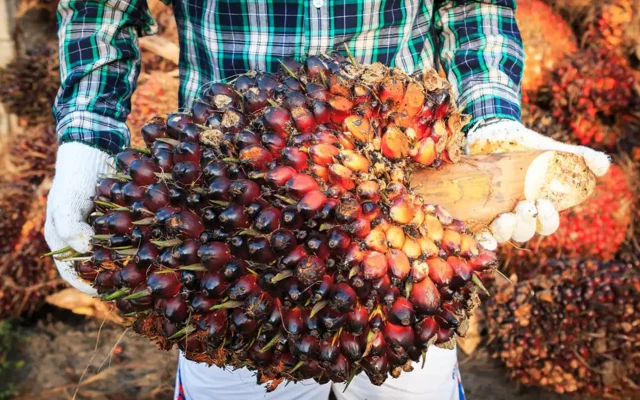
Africa’s growing palm oil sector, anchored by top exporters like Côte d’Ivoire, Kenya, Gabon, Liberia, Uganda, carries serious human trafficking risks
Roughly 70% of production comes from smallholders who lack credit and market access, while large-scale plantations drive land displacement and environmental harm. Workers face hazardous conditions, including pesticide exposure and weak protection, while child labor and exploitation of migrant laborers are documented. Displacement and inequitable land deals further deepen trafficking vulnerabilities.
Overview of palm oil production in Sub-Saharan Africa
Trade
The top exporters of palm oil in sub-Saharan Africa as of 2024 were Côte d’Ivoire, Kenya, Gabon, Liberia, Uganda.[1]
The top importers of palm oil in sub-Saharan Africa as of 2024 were Kenya, Djibouti, South Africa, Uganda, and Mozambique.[2]
Features of Production and Supply Chain
Palm can be grown on large plantations or in smallholder schemes. Large palm oil companies usually have their own plantations, mills, and processing plants. Globally, smallholders account for approximately 27 percent of oil palm cultivation. In West and Central Africa, their share is significantly higher, cultivating around 68 percent of the area devoted to this crop.[4]
Independent smallholders can seek out the highest available prices for mill purchase of their product; however, they may lack market access including credit for inputs. “Supported smallholders” or outgrowers are tied to mills through a variety of relationship models. Generally, they receive access to credit and/or technical assistance in return for a promise to sell their product.[5]
Analyses of historical and concession data show that although agreements were signed between 2000 and 2015 for more than 4.7 million hectares of planned palm oil plantations in West and Central Africa, only a relatively small fraction of these areas has actually been developed as commercial plantations. It is estimated that only around 220,000 hectares have actually been converted to oil palm plantations in recent years, largely due to community resistance, investment constraints, and implementation challenges.[6]
Palm oil trees come to maturity approximately three years after planting. After three years of applying herbicides and pesticides, weeding, and cultivating the growth of oil palm trees, smallholder farmers or workers can harvest the palm fruit which grows in bunches. Palm bunches are removed from trees by hand using a sharp tool, such as a scythe, and loose fruits are collected from the ground. A palm bunch can weigh 55 pounds and contain 3,000 fruits. Harvest periods typically last fewer than 48 hours.[7][8]
Palm bunches are transported to mills after harvesting, and then it is passed on to processing plants, where palm oil is produced from the flesh, and palm kernel oil is produced from the kernel of the fruit. For every ten tons of palm oil, one ton of palm kernel oil is Oil may be further processed to produce derivatives of varying densities. The derivatives may also be blended with other vegetable oils.[9] Oil may be further processed to produce derivatives of varying densities. The derivatives may also be blended with other vegetable oils.[10]
Palm oil or its derivatives are present in up to 50 percent of all products in grocery stores.[11] Sometimes labeled as “vegetable oil,” it is used in products including fuels, soaps and shampoos, processed foods, cereals, baked goods, margarine, cosmetics, confectionary items, cleaning products, detergents, toothpaste, and candles. Since 1970, the global demand for vegetable oils has increased by over one hundred metric tons. This has been attributed to the use of vegetable oils in consumer products, as well as an increasing demand for biodiesel fuels in developed countries. Since 1990, global consumption of palm oil has increased fivefold.[12]
Per a 2020 report, global demand for palm oil is projected to increase from 76 million tons in 2019 to between 264 and 447 million tons by 2050, driven largely by the growth of economies and markets such as India and China.[13]
Key Documented Trafficking in Persons Risk Factors in Palm Oil Production
According to 2024 U.S. Department of Labor reporting, child labor occurs in cultivating palm fruit in Sierria Leone.[14] Of the top exporters of palm oil in sub-Saharan Africa, the 2025 U.S. Department of State Trafficking in Persons Report notes that Cameroonians are forced by recruiters to work on palm oil plantations in the northern part of Gabon.[15]
Undesirable and Hazardous Work
Studies on working conditions on oil palm plantations in sub-Saharan Africa document significant risks to workers’ health and safety. A systematic review of occupational risks revealed that workers on oil palm plantations in Ghana and Cameroon face increased risks of musculoskeletal injuries, exposure to infectious diseases such as malaria and leptospirosis, and contact with hazardous agrochemicals, reflecting broader deficiencies in workplace protection and occupational health measures.[16]
Research in Ghana further shows that plantation work is associated with high levels of physical injury during agricultural operations, underscoring the need for improved safety education and consistent provision of personal protective equipment. [17] Furthermore, a recent analysis of occupational health policies indicates that comprehensive protective measures, including chemical safety protocols and routine health checks, continue to be lacking for palm oil workers, leaving them vulnerable to harmful exposures and inadequate safety measures in the workplace.[18]
Research on the palm oil sector in the industry in general indicates that the development of oil palm plantations is often accompanied by systematic violations of workers’ rights, including unsafe and unhealthy working conditions, lack of free and fair remuneration, and limited access to collective bargaining and legal protection. These structural labor problems are linked to broader socioeconomic vulnerabilities in plantation areas, where employment contracts can be precarious and labor protection standards are insufficient or unenforced, increasing the risks of exploitation. [19][20]
Vulnerable Workforce
Child Labor
The U.S. Department of Labor has reported that children are involved in the cultivation of palm fruit, the key input for palm oil, in Sierra Leone.[21]
Prevalence of child labor varies significantly among the top exporting countries of production. Per 2021 reporting, the year for which most countries had data available, Uganda has the highest rate (40.8 percent), followed by Gabon (11.8 percent), and Kenya (4.3 percent). 2021 data were not available for Côte d’Ivoire and Liberia, however rates in Côte d’Ivoire for 2022 were reported at 12.8 percent and in Liberia were reported at 21.1 percent per 2020 data. Only countries for which 2021 data are available (Kenya, Gabon, and Uganda) are plotted on the graph below.
Migrant labor
In Côte d’Ivoire and Kenya, internal and cross-border migration is part of a broader agricultural labor dynamic that extends to plantation crops, which could include oil palm. While detailed data on the employment of palm-specific migrants remains limited, labor market studies in Côte d’Ivoire document sustained rural labor mobility and the participation of foreign workers in agricultural sectors, reflecting the structural dependence on migrant labor in plantation economies. In Kenya, migration from rural to rural areas contributes to the labor supply in labor-intensive crops, including emerging oil palm projects.[23]
The proportion of migrant populations varies significantly among the top five exporters of palm oil. Gabon has the greatest proportion of migrants as a share of its population, reaching 19 percent, while the share migrants in both Kenya and Liberia are reported at just two percent.[24]
Contextual factors contributing to trafficking in persons vulnerability
Social and Human Development Factors
As of 2024, Liberia had the lowest Human Development Index (HDI) score at 0.51 while Gabon had the highest score at 0.733. The HDI is a composite index on a 0 to 1 scale, where a higher index score means a greater degree of human development, that measures a country’s average achievement in three basic dimensions of human development: life expectancy at birth, education (average and expected years of schooling), and gross national income per capita.[25]
Per 2024 estimates, Gabon had the highest unemployment rate among the top palm oil-producing countries, at 20.1 percent, whereas Liberia, Uganda, and Côte d’Ivoire all have reported unemployment rates under three percent. The unemployment rate measures the proportion of the total labor force that is unemployed but available and seeking work. These figures show substantial variation across countries, with Gabon facing significantly greater labor market constraints compared to the others, while Côte d’Ivoire, Uganda, and Liberia reflect relatively low official unemployment rates.[26]
Association with Labor Intermediaries
Labor can be mediated by third parties (contract managers, contractors, or agencies) in at least some producing countries. Labor intermediaries recruit Cameroonian workers to work, including by force, on palm oil plantations in northern Gabon.[27] In Cameroon, the Round Table on Sustainable Palm Oil (RSPO) National Interpretation for Cameroon considers that contract workers include workers “employed by a contractor or consultant with whom the company has a direct contract,” and its guidelines for worker protection explicitly provide for agreements between the employer and the agency.[28]
In Ghana, an RSPO certification assessment report for Norpalm Ghana Ltd. documents that the company used (and planned to expand use of) external contractors to manage “contract workers” and “casual workers,” noting deficiencies such as the absence of direct employment contracts between contract managers and contract workers, and explicitly describing management’s decision to “transfer casual workers to external contractors” (including identifying multiple contractors who would “handle these contracts”).[29]
Association with Large-scale Land Acquisition and Association with Armed Conflict
In Benin, the government’s national program for the palm oil sector notes that, since 2010, foreign investor groups from China, Malaysia, and South Africa have submitted proposals to establish large industrial palm oil plantations (with projects ranging from tens to hundreds of thousands of hectares), reflecting continued interest in accessing large tracts of land for palm oil development.[30]
Industrial palm operations have been associated with conflict and episodes of violence in the sub-Saharan Africa region. In Nigeria, for example, Okomu Oil Palm Company Plc. reported repeated violent incidents on and around its farms: in February 2022, the company stated that it had suffered multiple attacks in a short period of time, including the suspension of its operations following a fatal incident.[31][32] , More recently, in May 2024, Okomu publicly confirmed another serious attack on its facilities that resulted in the death of three plantation workers and others injured. The company has also faced allegations of alleged violations of the rights of the host community, including the exclusion of residents, harassment of community leaders through the intervention of security forces, and land grabbing. However, the company rejects these accusations and maintains that it has not engaged in any wrongdoing.[33][34]
In Burundi, conflicts have frequently arisen over use of land for palm oil cultivation, and competition for land in the densely-populated country has intensified this problem.[35] Refugees returning to the country have found that their land has been given away to people with connections to local elites for palm oil production.[36] The parastatal Office of Palm Oil has also taken large parcels of land for palm oil production without providing compensation.[37]
In Cameroon, palm oil companies have been the subject of constant criticism for large-scale land acquisition, which affects indigenous and local communities. In the Littoral region, the agro-industrial company SOCAPALM has been accused of occupying traditional lands without adequate compensation, leading to the displacement of communities and long-standing disputes over land access.[38]
In Liberia, disputes over large oil palm concessions continue to give rise to reports of intimidation and criminalization of members of local communities. Journalistic investigations document arrests of villagers by armed police and security personnel linked to the company, following accusations of “palm nut theft” at Golden Veroleum Liberia (GVL) facilities. According to community testimonies, these events are related to ongoing conflicts over access to land and livelihoods.[39] Similarly, in West Africa, communities impacted by the operations of the Belgian agro-industrial group SIAT have developed transnational advocacy strategies. According to AEfJN, in June 2022, representatives of communities in Ghana, Nigeria, and Côte d’Ivoire publicly denounced alleged land grabbing and its impacts on human rights, including a demonstration in front of SIAT’s headquarters in Zaventem (Belgium), which shows how land conflicts linked to industrial oil palm projects can escalate beyond the national level and become coordinated international pressure.[40]
In the past, the UN Panel of Experts on Liberia expressed concerns over the risk of conflict in concessions to palm oil companies. Some community members who have objected to plans for expansion of plantations have claimed that security personnel from palm oil companies have harassed and intimidated them.[41] Palm oil expansion has increased local communities’ vulnerability by reducing food security and livelihood opportunities.
Recent investigations continue to document conflicts linked to palm oil expansion in sub-Saharan Africa. In Sierra Leone, an independent public report on Socfin/SAC operations documented community complaints related to land access, consultation processes, and disputes over compensation and reparations, including concerns about claims management and the effective participation of affected people.[42]
In Liberia, civil society organizations have publicly pointed out that controversies persist regarding customary land rights and decisions within the RSPO grievance system. Various public communications have questioned the lifting of suspension orders on oil palm projects, raising concerns about compliance with rights safeguards and effective access to remedies for affected communities.[43][44] In Nigeria, monitoring by civil society and research organizations has similarly documented tensions related to concession development, including allegations of insufficient compensation, disputed land demarcations, and complaints related to community participation in decision-making processes.[45]
As part of national strategies aimed at strengthening economic growth and competitiveness in global commodity markets, the Government of Cameroon has actively promoted the expansion of rubber and palm oil production. However, research and civil society monitoring have raised concerns that the rapid development of large-scale plantations has been associated with risks related to legal compliance, human rights protection, and fairness in land tenure arrangements. These developments have been linked to reports of land concentration, environmental degradation, and disruption of traditional social and cultural systems, which in turn can contribute to social tensions, livelihood insecurity, and community grievances.[46]
In broader terms, international analyses continue to document that, in contexts of conflicts over land and resources associated with extractive and agro-industrial industries, community leaders and human rights defenders may face intimidation, threats, or pressure when they oppose projects, which increases risks to meaningful participation and informed consent in affected territories.[47]
Association with Environmental Degradation
The expansion of palm oil in sub-Saharan Africa is increasingly debated in relation to environmental pressures arising from land conversion and forest loss, especially when new plantations overlap with carbon-rich or biodiverse landscapes. Regional sustainability initiatives, such as the African Palm Oil Initiative, emphasize that oil palm development plans in African producing countries need stronger safeguards, precisely because deforestation, land use change, and associated greenhouse gas impacts are key risks in the sector.[48] At the same time, environmental evidence from West Africa shows that palm oil processing can generate localized pollution loads: field research in Nigeria has documented measurable deterioration in stream water quality at palm oil mill effluent (POME) discharge points and downstream, highlighting the importance of proper effluent management to protect community water resources.[49]