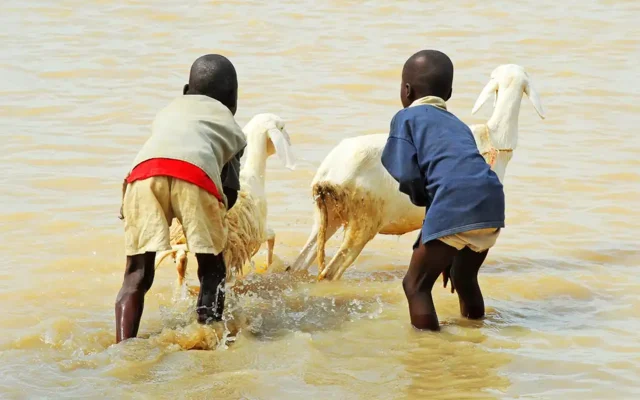
Livestock production in Sub‑Saharan Africa exposes workers to trafficking and exploitation through child labor, forced labor, unsafe conditions, and opaque hiring systems.
Livestock is a vital livelihood across Sub‑Saharan Africa, with most production run by smallholders using family labor and a growing export trade in live animals and meat from countries like South Africa, Namibia, Botswana, Sudan, and Uganda. Children are often engaged in herding family cattle, and in regions like Lesotho and Namibia herding starts as early as age three. Boys may be sold or trafficked across borders into abusive work. On commercial farms, hired laborers may earn less than minimum wage, be tied to debt through employer-run stores, lack ownership rights, and face restricted mobility—all compounding vulnerabilities to trafficking, forced labor, and exploitation.
Overview of livestock production in Sub-Saharan Africa
Trade
The top exporters of meat from sub-Saharan Africa are South Africa, Namibia, Botswana, Sudan, and Uganda.[1]
[2]
The top importers of meat from sub-Saharan Africa are South Africa, Mozambique, Norway, Lesotho, and Egypt.[3] [4]
The top exporters of live animals from sub-Saharan Africa are Namibia, Sudan, South Africa, Mauritius, and Tanzania. [5]
[6]
The top importers of live-animals from Africa are South Africa, Egypt, Mauritius, Saudi Arabia, China.[7]
Features of production and supply chain
Livestock and pastoralism are a critical livelihood strategy in Africa, and livestock typically represent a valuable asset for many of the continent’s poorest rural dwellers. Animals graze on over half the land in sub-Saharan Africa.[8]
[9]
The World Bank and FAO describe four types of livestock raising systems. Pastoral and semi-nomadic systems are “low-input, low-productivity” systems found in the Sahel region, northern sub-Saharan Africa, and the Horn of Africa. Outputs such as milk, meat, and live animals are sold in traditional markets, and animals may be exported to neighboring countries. Agro-pastoral systems are found in semi-arid regions and products are consumed locally. Urban-based livestock keeping refers to dairy, poultry or pig farming that occurs near urban centers10. Again, almost all outputs are consumed locally. Large commercial livestock farming is found primarily in Southern Africa. Meat outputs are consumed locally, regionally and exported.
[11]
Traditional, small-scale, subsistence livestock agriculture accounts for the vast majority of production – up to 95 percent [12] – but production for export requires specialized commercial operations, limiting the number of farmers who can produce at export scale.[13] According to 2014 FAO data, there are approximately 330 commercial livestock enterprises in Tanzania, 527 in Botswana, and 254 in Malawi.[14] In Botswana, over 20 percent of cattle are produced by five farmers.[15] That said, fattening of cattle that ultimately enter commercial supply chains may be conducted by small-holders, in addition to feedlots.[16]
Small-scale or subsistence herders predominantly rely on family labor, increasing the incidence of child labor. There is also some evidence that hired labor is utilized by small-holders, albeit at low levels. Conversely, commercial farms, which can be upwards of 65,000 hectares,[17] rely on hired workers.[18]
Historically, the vast majority of African livestock production has been for domestic or local regional consumption. Longer distance trade opportunities had previously been derailed by disease and drought, but more recently, international markets in Europe and the Middle East have been opening to African exports.[19] Beef specifically is a key export, primarily going to Hong Kong and mainland China, the EU, Japan and Mexico.[20]
Key documented trafficking in persons risk factors in livestock production
According to the U.S. Department of State 2016 Trafficking in Persons Report, forced labor or forced child labor is involved in cattle production in Botswana, Chad, Gabon, Kenya, Malawi, Mauritania, Namibia, Swaziland, Tanzania and Uganda.21 The 2016 U.S. Department of Labor List of Goods Produced by Child Labor or Forced Labor, notes forced labor in cattle ranching and herding in Niger and South Sudan.[22]
Undesirable and hazardous work
Working with cattle can carry a variety of health and safety risks. These include animal-related disease, long hours in extreme weather conditions, dust inhalation, confrontation with cattle raiders, injuries from handling livestock and tools, and musculoskeletal disorders.[23]
Little information is available about hired workers on commercial farms, but where information does exist, it appears that hired workers may be a vulnerable group. In a study of hired workers on livestock farms in Namibia, many were not receiving minimum wage.[24] Most hired workers were not allowed to own their own cattle or large stock animals.[25] The study found that due to low wages, workers took credit from their employer, the interest on which could inhibit their mobility.[26] On commercial farms, this could take the form of credit or inflated prices at a store on the premises, run by the farm owner or family members, taking advantage of the isolated nature of the worksites.[27]
Vulnerable workforce
Child labor
The 2016 U.S. Department of Labor List of Goods Produced by Child Labor or Forced Labor, notes child labor in Chad, Ethiopia, Lesotho, Mauritania, Namibia, South Sudan, Uganda, and Zambia.[28]
[29]
In many sub-Saharan African countries children are involved in herding family cattle, and the U.S. Department of State reports that some of these children may be victims of forced labor and sold in markets.[30] Children may be sold by their parents into cattle herding as a means of earning small amounts of money. Boys from Angola are reportedly trafficked within the Namibian cattle herding sector.[31] In Botswana, some children from poor families in isolated rural communities may migrate to live with wealthier extended family members and some of their work may include cattle herding. These children may be treated worse than other children living in the household, and may be excluded from educational opportunities, physically confined, or otherwise abused. [32] Herding is integral to Basotho culture.[33] CNN reported in 2013 that about one third of boys in Lesotho are shepherds and do not attend school.[34] These boys can begin herding as young as three years old.[35] In part, this high rate of child labor has been a reaction to adult men migrating to South Africa for work in mines.[36]
Children are often engaged in herding, which involves keeping groups of animals together, and is common in pastoral agricultural and nomadic societies. Livestock tasks tend to be distributed along gender lines: cattle herding is generally a task for men and boys, and herding activities can begin as young as five years of age. Culturally, herding is viewed as an opportunity to contribute to family income and to earn income. Herding is one of the tasks most associated with child labor in the cattle and livestock sectors. Children may also participate in other tasks such as animal husbandry, slaughter, milk processing, meat processing and leather preparation. [37]
Heredity/traditional slavery
Trafficking in cattle herding can be associated with hereditary or inherited slave status. In Mauritania, inherited slavery may force individuals to work as unpaid cattle herders. Botswanan officials have confirmed instances of forced labor involving children and adults belonging to the San, a minority ethnic group in Botswana. The U.S. Department of State also reported that San and Zemba children in Namibia are at increased risk of trafficking vulnerability.[38]
Contextual factors contributing to trafficking in persons vulnerability
Association with large-scale land acquisition
Development of land for commercial ranching can displace rural populations. For example, the Kalahari San were displaced from traditional land in Botswana by commercial agricultural development.[39] Large-scale land acquisitions for commercial livestock operations have been noted in Ethiopia and Sudan.[40]