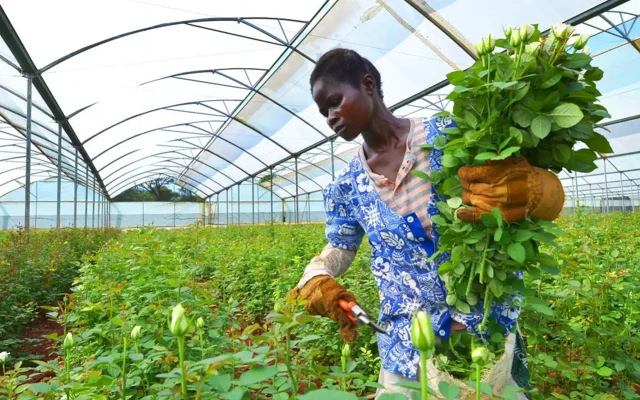
Flower exports from Kenya, Ethiopia, South Africa, Zambia, and Tanzania bring significant revenue but also carry trafficking risks.
Up to 17% of the global cut flower trade comes from Sub-Saharan Africa, where workers face hazardous conditions such as pesticide exposure, extreme heat, and poor ventilation. With women making up most of the workforce, risks include sexual harassment, insecure contracts, and poor housing. Reliance on casual and migrant labor, alongside weak oversight, compounds vulnerabilities to exploitation.
Overview of flower production in Sub-Saharan Africa
Trade
The top exporters of flowers from sub-Saharan Africa are Kenya, Ethiopia, South Africa, Zambia and Tanzania.[1]
Total African cut flower production is worth USD 1.4 billion annually and accounts for 17 percent of the global flower trade.[2] Cut flowers account for 12 percent of Kenyan export revenues and 11 percent of Ethiopian export revenues.[3] Kenya provides 7 percent of the global market share for cut flowers, while Ethiopia accounts for 2 percent.[4] Kenya has maintained a competitive advantage in part due to excellent transport links to Europe, allowing for rapid shipping of fresh flowers.[5] Roses are the majority of export flower crops.[6]
The top importers of flowers from sub-Saharan Africa are the Netherlands, the United Kingdom, Germany, Russia and Norway.[7]
The Netherlands is far and away the largest importer of African cut flowers, accounting for 80 percent of Ethiopian exports and 46 percent of Kenyan exports. The next largest importers of Kenyan cut flower exports are the United Kingdom (12 percent), Russia (8.4 percent), Germany (7.9 percent), and Norway (6.2 percent).[8] Saudi Arabia and the United Arab Emirates are the next largest importers of Ethiopian cut flower exports (7.8 percent and 3.7 percent respectively).[9]
Features of production and supply chain
2,500 hectares in Kenya and 1,700 hectares in Ethiopia are currently dedicated to flower production.[10] In Kenya there are 127 flower farms currently in operation, with over 500,000 people in the country depending on the industry for their livelihoods (90,000 are directly employed on farms).[11] In Ethiopia, it is estimated that over 180,000 jobs have been created by the rapid rise of the flower industry, and that 85 percent of those employed in the industry are women.[12] Foreign demand and foreign investment drives the cut flower industry in both countries. Large commercial operations are the primary producers for export, as high costs for inputs, production costs and international quality demands are barriers to smallholder participation. However, small farms are present as well, and act as sub-contractors for the larger farms, typically growing “filler” flowers that have less stringent quality and input requirements.[13] These sub-contracting arrangements lend a level of opacity to the supply chain, although they represent about 10 percent or less of the overall output.[14]
Across the sub-Saharan African horticulture sector in general, high power costs, changeable weather patterns, and poor infrastructure are barriers to development and expansion.[15]
Key documented trafficking in persons risk factors in flower production
Undesirable and hazardous work
There is evidence that the hazardous chemicals used in the growing of cut flowers in Kenya and Ethiopia have produced adverse health effects in some industry workers.[16] Specific abuses have included spraying of pesticides in greenhouses in which workers are laboring, fumigation of cold storage facilities as workers labor inside of them, and maintenance of working conditions in extreme heat with few or no breaks.[17] One study of Ethiopian workers in the industry found a “high prevalence of respiratory and dermal symptoms” that did not exist in control testing, and noted that workers who labor inside greenhouses were significantly more likely to develop symptoms that those who worked outside.[18]
Vulnerbale workforce
Gendered dynamics of production
Women are the majority of workers in the flower sector – up to 75 percent of the workforce in Kenya – and women work in the industry’s most labor-intensive positions.[19] Gender issues compound the other existing risks present in the sector. For example, poor housing conditions and security around flower farms have contributed to an increased risk of rape.[20] Sexual harassment is a persistent problem.[21] One report compiled by the Kenyan government in 2011 found that a majority of the women surveyed believed that sexual harassment is not adequately reported and/or investigated, and that the women’s committees set up to address such concerns lack credibility among male coworkers/managers.[22] Female workers tend to be low-skilled, lacking education and literacy, and therefore have few other employment options.
Casual labor
A 2011 report compiled by the Kenyan government found that casual or short-term work was fairly prevalent in the country’s cut flower industry, in spite of international standards – particularly requirements for export to EU markets – that have sought to strengthen protections for workers. In some cases, workers were found to have worked for companies for years without being transitioned to permanent status and were therefore denied benefits. In other cases, workers had no contracts at all. One farm had long-term employees misclassified as temporary, and denied those workers pay slips and overtime pay.[23]
Migrant labor
Internal migration is common in the flower industry, and in Kenya there has been notable migration to the flower-growing region of the Naivasha basin.[24]
Contextual factors contributing to trafficking in persons vulnerability
Association with environmental degradation
Rose production is highly water intensive, posing challenges in countries that contend with existing water scarcity. Droughts linked to climate change have compounded the problem.[25] In Kenya, flower cultivation is concentrated around Lake Naivasha. The lake’s water levels have dropped considerably, which is attributed in part to the fact that each rose uses about ten liters of water during cultivation.[26] The lower water levels have had a particular impact on the Maasai population, who used the lake as a water source for livestock during the dry season. Fishing on the lake has become untenable.[27] Conflicts over water in the region have reportedly caused death and displacement of local populations.